Get Full Government Meeting Transcripts, Videos, & Alerts Forever!
Get email alerts on the Water Policy topic
No spam. Unsubscribe anytime.
Court hears plan for community‑based water implementation amid state drought declaration
Summary
Harney County Court discussed an implementation collaborative to put community‑based water planning into action, the relationship to Oregon Division 512 curtailment rules, and the governor's drought declaration; court emphasized voluntary local measures, requests for state resources and the need for county‑level commitments.
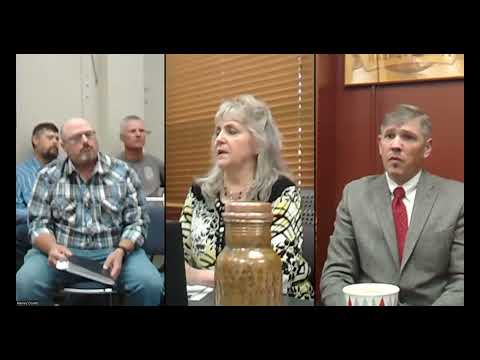
Harney County Court spent a large portion of its June 17 session on water planning: how a community‑based implementation collaborative might support irrigation efficiencies and voluntary agreements, and how those voluntary actions intersect with state Division 512 curtailment rules and a recent drought designation.
Court members reviewed Executive Order 2699, the governor’s drought emergency declaration that includes Harney County; officials said a state declaration can help unlock federal programs (forage assistance through FSA, NRCS cost‑share) but noted that state action is primarily procedural and that the federal agencies provide direct program support.
The court also discussed an implementation collaborative emerging from the community‑based integrated water plan. Participants described the collaborative as a boots‑on‑the‑ground facilitator that could help producers access cost‑share for irrigation upgrades, install totalizing flow meters, and run outreach in seasons that work for producers. “This implementation collaborative will likely host meetings so OWRD can be an invited technical guest rather than the one delivering dense, jargon‑filled slides,” one participant said.
Participants debated the relationship to Division 512, the state's curtailment rules, and the degree to which voluntary, preemptive conservation could reduce the impact of future enforced curtailments. County leaders framed the collaborative as a way to implement conservation measures now rather than wait for enforcement timelines, and they said the county’s role is to stay engaged and set county‑level commitments rather than tie actions to an individual officeholder.
Why it matters: Groundwater and surface‑water management are central to Harney County’s agricultural economy. The collaborative’s success could affect how water is used, whether producers can meet future curtailments with less economic disruption, and the county’s ability to attract state and federal support.
Next steps: The court agreed to remain engaged with the collaborative and to define county commitments that focus on participation and coordination; the collaborative will pursue funding, staffing and outreach strategies to support producers in implementing on‑the‑ground conservation measures.