Get Full Government Meeting Transcripts, Videos, & Alerts Forever!
Get email alerts on the Service Delivery Policy topic
No spam. Unsubscribe anytime.
MBTA proposes new reliability, accessibility and crowding measures in 2024 Service Delivery Policy update
Summary
MBTA staff presented a 2024 update to the Service Delivery Policy proposing a switch to an 'excess trip time' reliability metric for heavy rail, penalties for dropped bus trips, new accessibility measures for stops, docks and vessels, and a crowding metric for heavy rail; a 21‑day public comment period is open.
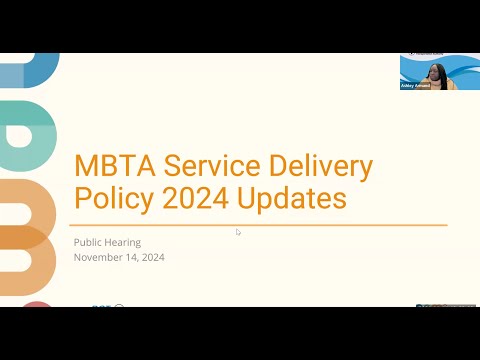
The Massachusetts Bay Transportation Authority held a virtual public hearing to present proposed updates to its 2024 Service Delivery Policy and to seek public feedback, MBTA officials said. "Tonight's hearing is to share information and receive feedback on the MBTA's 2024 update to the service delivery policy," Ashley Armand, the agency’s Deputy Director for Community Engagement, said.
MBTA staff said the most significant change would replace the heavy‑rail on‑time performance (OTP) metric with an "excess trip time" metric that measures a rider's full trip (wait time, travel time and dwell time) against a benchmark. "We are proposing to move to excess trip time, which we believe is a much more customer oriented and passenger experience oriented metric," Dan Zagarnik, Acting Chief of Operations, Planning, Scheduling, and Strategy, said. The MBTA opened a 21‑day public comment period and plans to submit a final draft to the MBTA Board of Directors in late December.
Why it matters: Staff said the new metric captures reliability problems that OTP can miss — including dropped trips, uneven headways, speed restrictions and extended dwell times — and therefore can change how the agency reports system performance. "The single biggest change ... is moving from our existing on‑time performance metric ... to a new metric," Lee Biernbaum, Manager of Performance and Reporting, said. Using fall 2023 data and the new approach, staff said that in early 2023 the system met expected travel time only about 15% of the time under the excess‑trip‑time calculation, a result Biernbaum said felt closer to riders’ experience than the older OTP numbers.
Reliability changes by mode: Staff said OTP will remain in use for bus and Green Line while data improvements continue. For buses, the policy would for the first time penalize dropped trips in on‑time calculations because the agency now believes it can distinguish between vehicles that truly did not operate and vehicles that failed to report location/time. On the Green Line trunk (the tunnel segment), MBTA staff said the policy will use scheduled headways when schedules are greater than three minutes rather than assuming a three‑minute headway all day, so measured performance better matches the published schedule.
Accessibility: The update adds measures for bus stop accessibility, ferry dock accessibility and ferry vessel accessibility. Biernbaum said a bus stop must include a landing area for ramps, a safe path to the nearest street crossing and no other major barriers to be counted as accessible. For ferries, staff said a dock must avoid excessive slope at varying tides and provide an accessible gangway or bridge plate, and vessels must meet width and AV/ restroom accessibility requirements. Using fall 2023 data, staff reported that just over 56% of docks were accessible by count, while a ridership‑weighted measure showed only about 30% of dock activity served accessible docks — indicating some high‑ridership docks remain inaccessible.
Platform elevator accounting: The policy would treat instances that require a rider to transfer via an accessible shuttle because an elevator is out of service as "inaccessible" rather than "accessible." Biernbaum said there is an exception: hours excluded when an elevator is closed for an accessibility project, such as replacement work. Staff said this change aligns with a settlement referenced in the presentation and that applying the new accounting reduces platform accessibility in the sample year from just over 99% to about 97.5%.
Passenger comfort and crowding: The MBTA would expand crowding metrics to heavy rail (red, orange and blue lines) using estimates from fare‑gate and other sensors to approximate onboard passenger counts. Staff noted limits in precision (for example, uncertainty about which car a rider uses) but said the estimate is reasonable across runs. For fall 2023, staff reported heavy rail met the comfort threshold 98.9% of the time under the preliminary definition (off‑peak assumed 10 square feet per standing passenger; peak assumed 3 square feet).
Other edits: The update also includes minor formatting and terminology changes (for example, renaming key bus routes as frequent routes, commuter rail as regional rail) and embeds a previously adopted diversion service standard into the SDP. Certain customer‑service metrics for paratransit were removed from the SDP report package but will continue to be reported separately.
Next steps and public input: MBTA staff encouraged attendees to submit written comments during the 21‑day public comment period to publicengagement@mbta.com. The agency plans to amend the document as appropriate and present it to the MBTA Board of Directors for final approval in late December.
The hearing then opened to public questions and comments under the rules explained by MBTA staff.