Get email alerts on the Trees And Vegetation topic
No spam. Unsubscribe anytime.
Conservation panel approves multiple tree removals with mitigation and snags
Summary
The Eastham Conservation Commission approved several tree‑removal and pruning requests on safety and health grounds, requiring mitigation in some cases and retaining habitat value by leaving snags where appropriate.
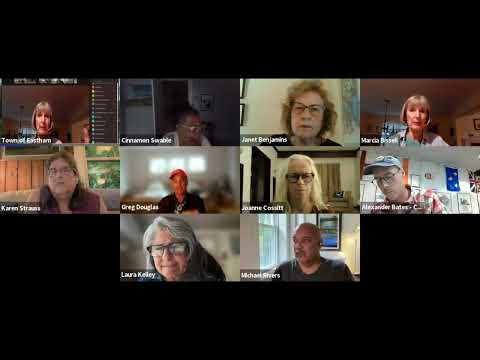
The Eastham Conservation Commission on June 23 approved a string of tree‑removal and pruning requests, ordering mitigation or habitat retention where staff and commissioners found it appropriate.
Marcia Bissell, the applicant for 60 Briggsville Road, told the commission she wanted six trees removed and one pruned because "they are in extremely close proximity to my house," and said roofers had warned the trees would shorten the life of a new roof. Commissioners who inspected the property recommended removing two unhealthy pines and a non‑native locust, pruning two oaks and allowing the crab apple in front to be removed with replacement by "a native fruit tree or a tree that would provide wildlife fodder," with two‑to‑one mitigation (half replacement trees, half shrubs). The motion to approve with those conditions passed unanimously.
At 300 Goody Howlet Drive the commission approved an administrative review to remove two dead cedar trees on the coastal bank (to be cut as snags) and to remove two dying cedars between houses with flush cuts; staff said the lot's dense vegetation made additional mitigation unnecessary. Commissioner Alex (staff) noted the owner was willing to create snags to preserve habitat value.
A more complex decision involved 95 Edgewood Road, where representative Chris Warren presented photos showing five large oaks and pitch pines crowding a historic house. After a lengthy, photo‑based discussion about which trunks posed the greatest hazard to the deck and roof, commissioners resolved to remove three of the marked trees, keep one dead tree as a snag and reduce another to a 12–16 foot snag. Commissioners emphasized 24 hours' notice to the conservation department before work and asked staff to attach the approved photo to the permit so contractors will know exactly which trees to address. "I wouldn't recommend mitigation because they are in a bunch of other trees and brush," staff said of one yard, but commissioners still asked applicants to consider replacement plantings where reasonable.
The commission framed these votes as balancing public‑safety concerns about trees overhanging structures against the commission's habitat and erosion‑control responsibilities, favoring targeted removal plus mitigation or habitat snags rather than wholesale clearcutting.
What happens next: permit conditions specify replacement plantings or shrub mitigation where required, snag heights, standard special conditions for pruning/removal, and the usual pre‑work notices to staff. Applicants who received approvals must schedule work with the conservation office and comply with the special conditions attached to each approval.
AI generated
The text on this page is AI generated. Summaries, highlights, analysis, and video transcripts are all produced from the original source material.
AI can make mistakes, so if you spot one, and we will fix it for everyone.
Note: the source content is unaltered by us. Any content source we link to, be it a video, an audio recording, or a document, is presented exactly as its publisher released it. That publisher is usually a government body, sometimes an individual official or another organisation.