Get email alerts on the Land Use topic
No spam. Unsubscribe anytime.
Camp Rising Sun seeks permit to run accessory conference programming; board flags parking, buffer and use-class concerns
Summary
Representatives of the Louis Auguste Jonas Foundation presented a request to allow accessory conference programming at Camp Rising Sun in Clinton; planning staff warned two proposed outdoor event areas fall inside a 500-foot buffer and asked for clarified parking plans, and the board scheduled a site visit for July 28 to refine permit conditions.
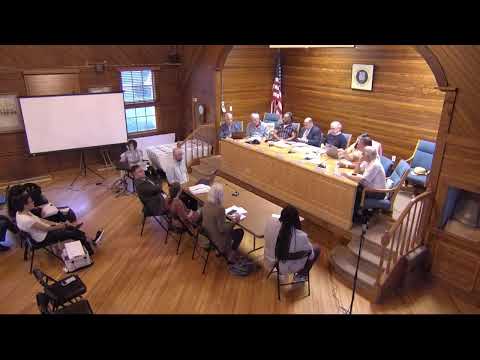
Representatives of the Louis Auguste Jonas Foundation outlined plans to use Camp Rising Sun's Clinton property for limited conference and educational programming outside the summer camp season and asked the Planning Board for a special permit to allow that accessory use.
Barry Fulton, the foundation's executive director, said Camp Rising Sun runs a full-scholarship leadership program and would like to expand into short, mission-aligned programs and occasional fee-based events to reduce an operating deficit. "We're looking for ways to expand our revenue base and preserve our endowment," Fulton said. Jill Fieldstein, director of operations, said the foundation is not proposing physical changes to the property and described capacity numbers for overnight and day programs.
Planning staff summarized recent memos and a building inspector determination that the proposed activities can be treated as an accessory conference center under the code but cautioned the board that it must set parameters so the use does not become a principal conference center. Staff noted parking and buffer constraints: two of the applicant's outdoor event areas fall within the code's 500-foot buffer, and parking areas must meet a 200-foot setback requirement. The planner also flagged that a single large wedding could draw roughly 300 people (about 120 cars), creating significant parking and traffic implications.
Board members debated the proposal's scale and whether the board could waive an engineered site plan. Several members said they might waive a professional site plan if the applicant limits programming to small educational "mini-camps" similar to current camp operations; conversely, frequent large social events or weddings would likely trigger a requirement for an engineered site plan and improvements to parking and circulation.
The board also discussed overnight capacity and county permitting; the applicant said the facility holds up to 53 beds in warm months (28 heated beds in winter) and that overnight multi-day programs would require appropriate county temporary residence permitting. The board agreed to a site visit on Tuesday, July 28 at 10:00 a.m. and asked the applicant to submit a clearer event list, a parking map showing proposed parking locations and buffers, and a refined (or simplified) site plan for the board's next review.
No formal permit was granted at the meeting. The planning board disclosed that Crawford & Associates had conducted prior work for the applicant in 2016 but said the firm has no current relationship; the board accepted using Crawford for review only after disclosure. The applicant accepted the board's requests and said it will return with additional documentation following the site visit.
AI generated
The text on this page is AI generated. Summaries, highlights, analysis, and video transcripts are all produced from the original source material.
AI can make mistakes, so if you spot one, and we will fix it for everyone.
Note: the source content is unaltered by us. Any content source we link to, be it a video, an audio recording, or a document, is presented exactly as its publisher released it. That publisher is usually a government body, sometimes an individual official or another organisation.