Get Full Government Meeting Transcripts, Videos, & Alerts Forever!
Get email alerts on the Data Access topic
No spam. Unsubscribe anytime.
How to get QWI data: API, data explorer and LEHD resources, a Census LED webinar guide
Summary
Presenters walked through how to access the Census Bureau's Quarterly Workforce Indicators (QWI): the QWI data explorer, FTP downloads, and a programmatic API (recommended for comprehensive queries); LEHD resources and the working paper are available on lehd.ces.census.gov.
The webinar provided step'by'step guidance on accessing the U.S. Census Bureau's Quarterly Workforce Indicators (QWI) for researchers and local planners.
Earline, host for the session, reminded attendees that the presentation and supplemental materials will be posted on the Census Academy site (census.gov/academy) within 30 business days and that LEHD resources and the presenter's working paper are available at lehd.ces.census.gov. "The presentation will be accessible on the Census Academy website at census.gov/academy under the webinar tab within 30 days," she said.
Joshua Bleiberg described three primary access methods: the QWI web extraction tool, FTP file downloads, and the QWI API, which he recommended for comprehensive, programmatic access. He noted an R package (tidyverse-style tools were mentioned in the Q&A) can simplify downloads for R users.
On technical practice, Bleiberg cautioned: researchers need an API key for programmatic access and he advised against sharing API keys with external large-language-model services. He said the API contains the most complete set of QWI records and is the quickest way to retrieve all available variables.
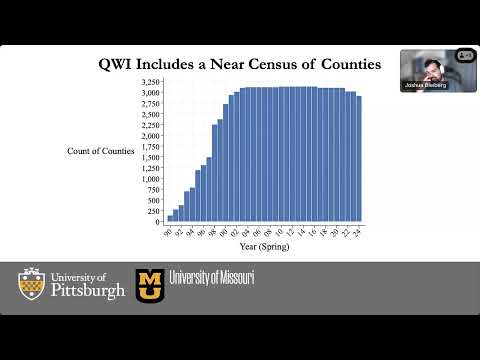
During Q&A, Bleiberg confirmed QWI produces quarter-by-quarter counts (employees, hires, separations) and that data are available at multiple geographic levels including states, counties, and metropolitan statistical areas; he noted QWI does not directly map to school-district boundaries but similar procedures combining ACS and QWI could generate district-level estimates.
Resources mentioned during the webinar include: the LEHD QWI explorer (lehd.ces.census.gov), the LEHD "Lehd in Action" page for the presenter's study, Census Academy webinar materials, and public documentation/FAQ pages describing how QWI is constructed and how states contribute UI records.
Takeaway: for local analyses of educator labor markets, the API plus the QWI extraction tool provide complementary approaches; researchers should consult LEHD documentation and request an API key through official channels when programmatic access is needed.