Get email alerts on the Land Use topic
No spam. Unsubscribe anytime.
Mount Angel council adopts development-code update after debate over multifamily density
Summary
After debate over whether to keep a 12-units-per-acre limit or adopt an 18-units-per-acre standard recommended by planning staff, the Mount Angel City Council approved the second reading of Ordinance 7 80, adopting the development-code updates presented in the original staff report.
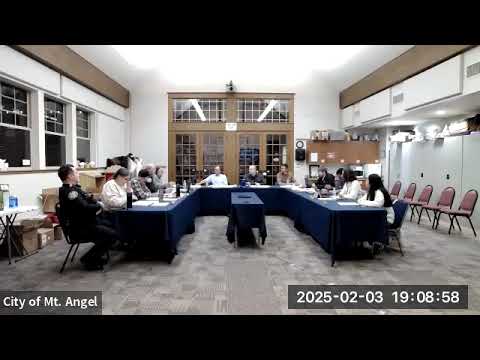
Mount Angel — The City Council voted to approve the second reading of Ordinance 7 80, a set of updates to the city's development code addressing multifamily standards, after a lengthy discussion about permitted residential density.
Colby, the planning staff member who prepared the ordinance, told the council the draft in the packet reflected the planning commission's recommended language and that the version in the staff report would provide more options for site layouts by varying lot-size and per-unit square-foot standards by unit type. "What you have in front of you was taken from the city of Albany," Colby said, explaining that the numbers had been modeled on other Oregon communities to better align with the city's housing needs analysis.
Several councilors questioned whether the code should change the current allowance of about 12 units per acre to the planning commission's 18-units-per-acre assumption. One councilor said the council's earlier reading left members uncomfortable because they did not know whether they were "signing up" for 16, 18 or another density. "I was uncomfortable voting for it," the chair said, noting the council had three procedural options: pass the ordinance as written tonight, pass it and amend later, or send it back to planning for further work.
Supporters said increasing allowed densities would help the city align with its housing needs analysis and make multifamily development more financially feasible. Opponents urged caution, noting the city had not seen large multifamily projects in recent memory and raised questions about concurrent infrastructure planning, particularly the water master plan.
Councilor Pulver moved to approve the second reading of Ordinance 7 80 as presented in the original staff report; the motion was seconded and the council recorded aye votes and approved the ordinance. Staff said the version adopted follows the planning commission's report and will be posted with the ordinance language.
The council and staff agreed that if the council later wanted to adopt a different per-unit standard than the planning commission's assumption, that change would require restarting parts of the public-notice and review process with the planning commission. The ordinance is effective according to the municipal code schedule for second-reading ordinances.
Next steps: staff will publish the ordinance text and continue coordination with the water master plan and other infrastructure planning to ensure code changes align with utilities capacity.
AI generated
The text on this page is AI generated. Summaries, highlights, analysis, and video transcripts are all produced from the original source material.
AI can make mistakes, so if you spot one, and we will fix it for everyone.
Note: the source content is unaltered by us. Any content source we link to, be it a video, an audio recording, or a document, is presented exactly as its publisher released it. That publisher is usually a government body, sometimes an individual official or another organisation.