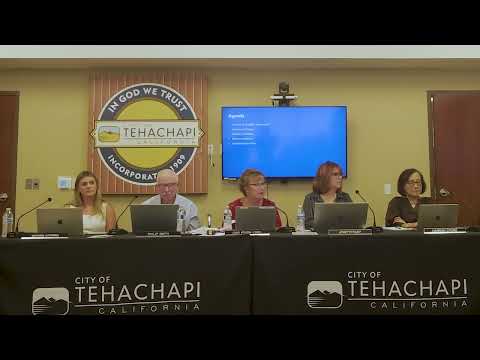
Council adopts Tehachapi transit plan with pilots for extended weekend service
Summary
The Tehachapi City Council unanimously adopted an updated five-year Transit Development Plan recommending pilots for extended Saturday hours and a new Sunday service, clear pilot metrics, and modest funding options; council members pressed consultants on survey size, ridership and funding implications.
The Tehachapi City Council voted unanimously to adopt an updated five-year Transit Development Plan that recommends piloting extended Saturday service and a new Sunday pilot, and sets guidance for operations, marketing and evaluation.
NelsonNygaard consultant Kyle Taniguchi presented the plan and told the council, “We’re here tonight to present to you the Tehachapi transit development plan.” The consultant said the report includes 16 recommendations across service, capital, operations and policy and proposes trialing two weekend pilots — roughly two extra hours on Saturday (for example, to 7:30 p.m.) and a Sunday pilot (possible hours 9 a.m. to 3 p.m.) — with predefined quantitative and qualitative metrics to judge success.
Why it matters: the plan is a five-year, cost‑constrained roadmap the city can use to prioritize projects and justify grant applications. Staff and the consultant said the city can fund current service and run the two pilots during the five-year horizon, but making expanded service permanent would require additional revenues or reallocation of existing transportation funds.
Council members asked detailed operational and fiscal questions during a lengthy Q&A. One council member pressed the consultant on survey reliability, noting concern about small sample sizes; the consultant said that in rural settings double-digit responses can be meaningful and that outreach was supplemented with pop-ups and virtual meetings. The consultant also confirmed reported daily dial-a-ride volumes in the plan fall in the range of roughly 14 to 32 riders aggregated across the service area.
The report recommends operational changes including exploring a mobile booking app to replace the current 24-hour call-in system, monitoring trip denials to improve dispatching, coordinating training and zero-emission planning with regional partners, and running a targeted marketing and travel-training campaign to increase awareness and customer comfort.
On funding, the consultant presented a five-year financial model showing the pilots are affordable within the plan’s horizon but noted that permanent service expansion would require additional revenue sources; staff said possibilities include reallocating Local Transportation Funds (LTF) or State Transit Assistance (STA) dollars and pursuing grants.
The council approved adoption by a 5–0 roll-call vote. The consultant and staff said they will return with implementation details and recommended pilot metrics for council review before any long-term commitments are made.
The next steps are for staff to work with Current Transit and Kern Transit partners to finalize pilot details, set evaluation metrics and identify funding sources before the pilots begin.
AI generated
The text on this page is AI generated. Summaries, highlights, analysis, and video transcripts are all produced from the original source material.
AI can make mistakes, so if you spot one, and we will fix it for everyone.
Note: the source content is unaltered by us. Any content source we link to, be it a video, an audio recording, or a document, is presented exactly as its publisher released it. That publisher is usually a government body, sometimes an individual official or another organisation.