Get email alerts on the Numeric Thresholds topic
No spam. Unsubscribe anytime.
Council debates whether 80/90/100 thresholds will drive cuts or allow a reporting default
Summary
Members split on whether to keep 80, 90 and 100 percent options in the appendix table; some argued a 100% default plus table proxies would let jurisdictions meet the appendix without real reductions, while others favored 100% to ease initial adoption.
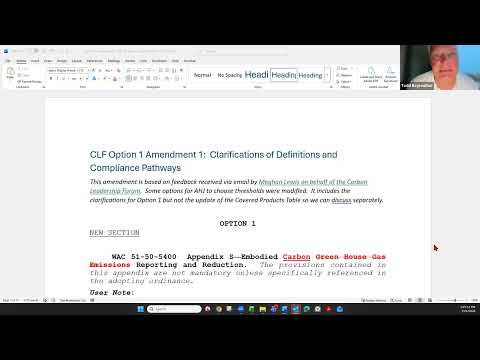
Council members spent substantial time debating numeric thresholds that jurisdictions could adopt under the materials (product compliance) pathway. Several council members expressed concern that a 100% option, when combined with CLF table values used as proxies for absent EPDs, could be gamed to meet the appendix without achieving net reductions.
"If you are allowing language that says over a 100%, there is no requirement because then everyone can use the values in the table," Megan Lewis, program director of the Carbon Leadership Forum, told the council. Vikram Sami argued that striking the 100% option would force jurisdictions to demonstrate actual reductions: "If we strike the 100% then it actually puts the onus on someone to actually do something..."
Other stakeholders urged a pragmatic, phased approach. Scott Bastiani said choosing a 100% option could help jurisdictions learn to use EPDs and reporting systems before more stringent requirements are phased in. "Everyone gets used to that process," he said, and incremental increases could follow in later code cycles. The council did not adopt a resolution; members asked sponsors to revise the amendment language and clarify how table proxies and thresholds should interact.
Next steps: sponsors will produce an updated amendment that addresses threshold language and the CLF table usage; the council requested revised material within about two weeks.
AI generated
The text on this page is AI generated. Summaries, highlights, analysis, and video transcripts are all produced from the original source material.
AI can make mistakes, so if you spot one, and we will fix it for everyone.
Note: the source content is unaltered by us. Any content source we link to, be it a video, an audio recording, or a document, is presented exactly as its publisher released it. That publisher is usually a government body, sometimes an individual official or another organisation.