Get email alerts on the Institutional Legitimacy Un Role topic
No spam. Unsubscribe anytime.
Journalists press why UN, not transitional authorities, is leading missing-persons work
Summary
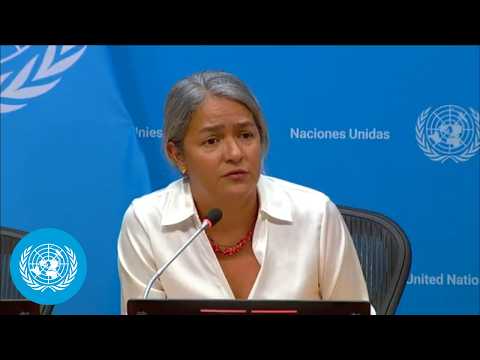
Reporters asked why the United Nations rather than transitional or national authorities is handling the missing-persons effort; Quintana said the institution exists because families requested it and that it works for Syrians regardless of which authorities are in power.
A correspondent asked why the task of finding missing Syrians falls to a United Nations institution rather than to national or transitional authorities. "Why is it the task for the UN staff to do this, not for this furious regime or transitional regime?" the questioner said, criticizing the UN and powerful states for failing to prevent disappearances.
Carla Quintana replied that the Independent Institution was created because families of the missing pushed for it and that it is a "unique institution" at the UN meant to work for families across eras. "The families of the missing in Syria needed an institution and need an institution to work on this, because they thought back then, this was 3 years ago, no 1 was giving them answers," Quintana said. She added that the institution's mandate covers both past and present disappearances and that the office continues outreach through the diaspora while seeking a local presence.
Quintana framed the institution's role as complementary to national authorities rather than a substitute for domestic responsibility and repeated that building trust with families and Syrian institutions is a work in progress.
AI generated
The text on this page is AI generated. Summaries, highlights, analysis, and video transcripts are all produced from the original source material.
AI can make mistakes, so if you spot one, and we will fix it for everyone.
Note: the source content is unaltered by us. Any content source we link to, be it a video, an audio recording, or a document, is presented exactly as its publisher released it. That publisher is usually a government body, sometimes an individual official or another organisation.