Get email alerts on the Planning Staff Briefing topic
No spam. Unsubscribe anytime.
Staff: rezoning request consistent with general plan but build‑permit issues remain
Summary
Parowan planning staff told the commission that rezoning the parcel to R‑1A is consistent with the general plan's light‑density residential designation, but noted that road improvements, flood‑channel setbacks, hydrant flow and building‑permit requirements would be evaluated later and could affect whether structures are permitted.
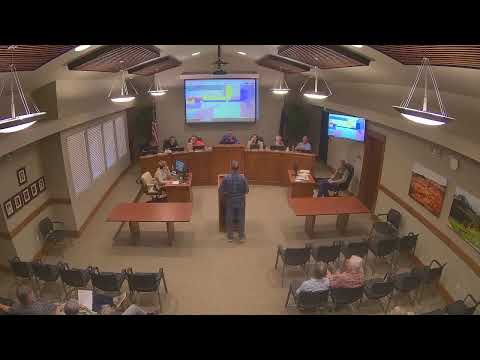
Planning staff provided technical context for the commission during the March 18 meeting. Staff (S2) explained that A‑1 residential development is treated, for many dimensional standards, under the R‑1 code and that the city’s future land‑use map designates the area as light‑density residential. "We look at the r 1 code because that's what the a 1 code refers to when it comes to residential development," S2 said, and added that the general plan supports light‑density uses in the area.
Staff also reviewed measurable constraints commissioners and neighbors raised: front‑footage rules (S5 and S2 discussed 75 ft and 65 ft figures for different zones), approximate parcel acreage (0.667 acres), flood‑channel setback practices (staff said the city typically advises about 75 ft from the channel centerline for building permits) and road/improvement distinctions between a building permit and a full subdivision. Staff emphasized that some parcel‑viewer measurements are approximate and that formal survey work or permit review could change conclusions about buildable areas or required infrastructure improvements.
AI generated
The text on this page is AI generated. Summaries, highlights, analysis, and video transcripts are all produced from the original source material.
AI can make mistakes, so if you spot one, and we will fix it for everyone.
Note: the source content is unaltered by us. Any content source we link to, be it a video, an audio recording, or a document, is presented exactly as its publisher released it. That publisher is usually a government body, sometimes an individual official or another organisation.