Get email alerts on the Lot Size And Auxiliary Units topic
No spam. Unsubscribe anytime.
Draft code would shrink lot minimums, expand ADU and caretaker allowances
Summary
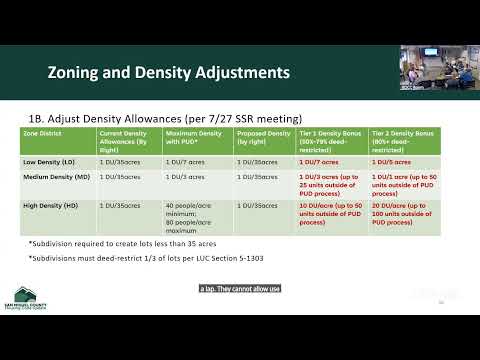
Draft proposes lowering minimum lot sizes (example: LD to 2 acres, MD to 1 acre), increasing ADU size caps (800 to 1,000 sq ft), allowing 2,000-sq-ft caretaker units on F-zone 35+ acre parcels and letting deed-restricted caretaker units offset mitigation fees.
Staff proposed significant changes to lot-size and accessory-unit rules intended to make infill and clustered development more feasible.
Kaye Simonson explained the rationale for the existing 35-acre minimum: "You simply cannot get a well permit for a new lot that's less than 35 acres." As a result, proposed minimums tied to infrastructure are: reduce low density to 2 acres (with by-right possibilities via tiers), medium density to 1 acre, and remove a minimum for the high-density zone where other standards will govern. Simonson also proposed increasing accessory-dwelling-unit (ADU) size allowances from 800 to 1,000 square feet in denser zones and retaining a 2,000-square-foot caretaker unit limit in the F zone for large parcels when those units are deed-restricted and occupied by qualified employees.
The presentation clarified mitigation fee treatment: subdivisions that dedicate deed-restricted lots are exempt from employee housing mitigation fees; standalone subdivisions or individual builds that do not deed-restrict will remain subject to the fee unless they mitigate by dedicating deed-restricted units.
AI generated
The text on this page is AI generated. Summaries, highlights, analysis, and video transcripts are all produced from the original source material.
AI can make mistakes, so if you spot one, and we will fix it for everyone.
Note: the source content is unaltered by us. Any content source we link to, be it a video, an audio recording, or a document, is presented exactly as its publisher released it. That publisher is usually a government body, sometimes an individual official or another organisation.