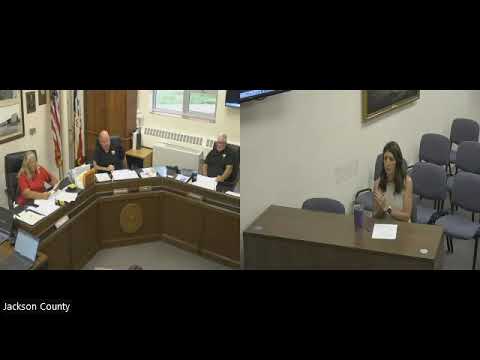
Environmental health director outlines plans for septic mapping, virtual inspections and PFAS testing
Summary
Elizabeth Townsend, the county’s environmental health director, said staff plan to buy a Traverse PC mapping platform and GPS equipment to modernize septic/well maps, continue a virtual‑inspection pilot, prioritize PFAS testing with DNR funding for up to 25 wells, and bring a new on‑site wastewater ordinance to the board by Sept. 8.
Elizabeth Townsend, environmental health director, told the board on July 28 that several program changes and grants will shape the department's work this year.
Townsend said revisions to the Iowa Administrative Code (chapter 69) effective July 12 require DNR guidance and that staff will attend a DNR meeting for sanitarians. She described a proposal to purchase Traverse PC software and associated GPS equipment to provide accurate GIS mapping of septic systems and wells; she said the county would pay about $1,000 a year for the platform and purchase a basic piece of equipment for roughly $3,000 (equipment options range from about $2,000–$5,000).
Townsend described a virtual inspections pilot in which contractors submit photographs of installed system components; after retooling the inspection for a sand filter to rely primarily on photos, the pilot produced better results. She also explained that the private well grant funded nearly all of last year’s work (about $65,000) but that the county’s new contract reduces annual funding to roughly $30,000 for the next three years. Given the reduction, the department is prioritizing PFAS testing along the Mississippi River: Townsend said the DNR received a $1,000,000 grant that could support testing of up to 25 wells in the county, and that DNR would fund reverse‑osmosis treatment for households with positive tests.
Townsend said the Board of Health approved a new on‑site wastewater ordinance and that she plans to bring the county ordinance to supervisors for consideration by Sept. 8. She cited challenges fitting systems in some Bellevue subdivisions, noted options including variances or city water hookups (estimated at $10,000–$20,000 per connection), and urged continued review and outreach.
AI generated
The text on this page is AI generated. Summaries, highlights, analysis, and video transcripts are all produced from the original source material.
AI can make mistakes, so if you spot one, and we will fix it for everyone.
Note: the source content is unaltered by us. Any content source we link to, be it a video, an audio recording, or a document, is presented exactly as its publisher released it. That publisher is usually a government body, sometimes an individual official or another organisation.