Get email alerts on the Sign Code topic
No spam. Unsubscribe anytime.
Commission supports sign‑code overhaul: 90‑day temporary signs, smaller setbacks, staff permits
Summary
Planning staff proposed and the commission backed revisions to the sign code (26‑13) to allow political signs in park strips (with owner consent), define temporary signs (about 90 days), reduce setbacks from 10 to 3 feet, and shift many conditional‑use reviews to staff‑issued sign permits; the city attorney advised removing a content‑based restriction on electronic message displays due to First Amendment concerns.
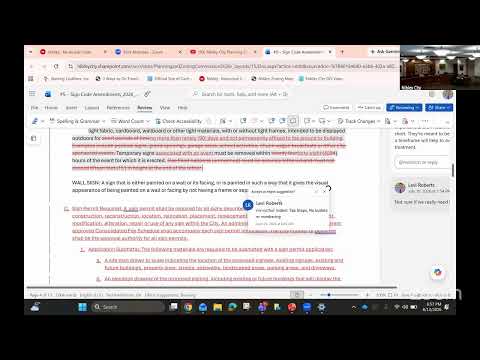
Planning staff told the commission the proposed amendments (26‑13, amending NCC 19.24.0.150) respond both to recent state legislation and a broader review of the local sign code. "The maximum time for a temporary sign is, I believe is 90 days is what we said," City Planner Levi Roberts said, explaining that after roughly three months a temporary sign would no longer be treated as temporary.
Roberts said the package would allow political signs in the park strip when the adjacent property owner agrees, reduce the typical setback for signs from 10 feet to 3 feet, and move many signs from a conditional‑use review to an administrative sign permit handled by staff. On electronic message display (EMD) signs, Roberts said the city attorney flagged potential First Amendment/content‑neutrality problems and recommended removing a content‑based restriction on EMDs.
Commissioners discussed enforcement and public‑safety concerns, then moved and seconded the staff recommendation and recorded a 5–0 vote in favor of recommending the sign‑code changes to city council.
AI generated
The text on this page is AI generated. Summaries, highlights, analysis, and video transcripts are all produced from the original source material.
AI can make mistakes, so if you spot one, and we will fix it for everyone.
Note: the source content is unaltered by us. Any content source we link to, be it a video, an audio recording, or a document, is presented exactly as its publisher released it. That publisher is usually a government body, sometimes an individual official or another organisation.