Get email alerts on the Environmental Streamlining topic
No spam. Unsubscribe anytime.
Commission adopts RCD’s environmental‑enhancement streamlining program, clears mitigated negative declaration and partial fee waivers
Summary
The commission approved the Resource Conservation District’s Environmental Enhancement Streamlining Program (EASP) — a five‑year master permit for up to five annual projects — adopting a mitigated negative declaration and recommending fee waivers (100% for master-permit fees; 50% for other construction/encroachment fees).
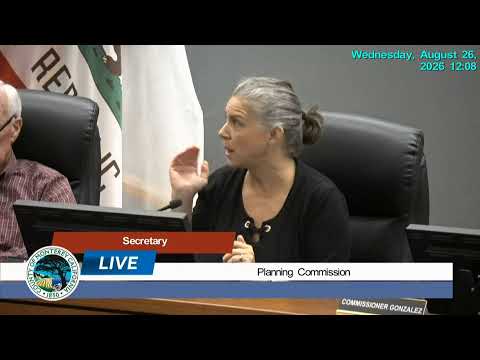
After a prolonged presentation and public comment, the Monterey County Planning Commission on Aug. 26 approved PLN 220358 to adopt the Resource Conservation District of Monterey County’s Environmental Enhancement Streamlining Program (EASP), including a programmatic Mitigated Negative Declaration (MND), a mitigation monitoring and reporting plan, and a staff‑recommended fee‑waiver package.
HCD staff described the EASP as a mechanism to streamline county permitting for a limited set of environmentally beneficial projects drawn from 13 NRCS‑based practice types. "This is a program to streamline county permitting for environmentally beneficial projects," staff said. Staff explained RCD will submit pre‑construction notices (PCNs) and a cumulative evaluation memorandum so state and federal agencies can review and comment before HCD makes a one‑month eligibility determination; eligible projects would be processed under the master permit rather than separate discretionary permits.
Staff also reviewed CEQA materials: a draft MND circulated for extended public review Sept. 11–Nov. 9, 2023, identified potential impacts across multiple resource areas and proposed five mitigation measures; staff made responsive edits after comments from the RCD and the California Department of Fish and Wildlife (CDFW). The staff recommendation included adopting the MND, approving the combined development/master permit for five years, and adopting a mitigation monitoring and reporting plan. Staff further recommended waiving 100% of combined development/master‑permit fees and 50% of future grading/building/encroachment permit fees, noting the most expensive construction permit would typically cost about $2,600 and that waivers affect HCD’s budget.
RCD presenters and the applicant urged that the program saves years in planning timelines for grant‑funded restoration projects. Paul Robbins, RCD executive director, said the goal is "to help to get conservation work on the ground more effectively and more in a streamlined manner." RCD staff presented a Moss Landing stormwater‑detention and habitat example and described a NRCS‑based nine‑step planning process with early agency consultation, design alternatives and monitoring and an annual cumulative report.
Public commenters from Big Sur raised concerns about notice and local review for projects that could affect critical viewsheds, native trees and ESHA. "There has to be a balance between streamlining that permit process and cutting the public out of that process," Trey Cropp of the Big Sur LUAC said; staff and RCD responded that the program includes early agency consultation, interest‑party lists and annual PCN disclosure and that some projects (e.g., those with structural visual impacts) would be routed for design approval and public hearing.
Commissioners questioned the program's ability to prevent cumulative impacts and asked how RCD and HCD would ensure state and federal permits are obtained before county processing. Staff pointed to the requirement that RCD include agency consultation in PCNs, the cumulative evaluation memo reviewed annually by agencies, and on‑the‑ground programmatic general conditions (PGCs) and mitigation measures. After discussion Commissioner Diehl moved staff’s recommendation; Commissioner Hartzell seconded and the commission voted in favor.
What this means: The EASP will operate for a five‑year term subject to annual reporting and a cumulative impacts evaluation; RCD may request an extension after the trial period and HCD will retain final eligibility determination authority on each PCN. Staff recommended interested parties use the annual reports and an interested‑parties list to track proposed projects.
AI generated
The text on this page is AI generated. Summaries, highlights, analysis, and video transcripts are all produced from the original source material.
AI can make mistakes, so if you spot one, and we will fix it for everyone.
Note: the source content is unaltered by us. Any content source we link to, be it a video, an audio recording, or a document, is presented exactly as its publisher released it. That publisher is usually a government body, sometimes an individual official or another organisation.