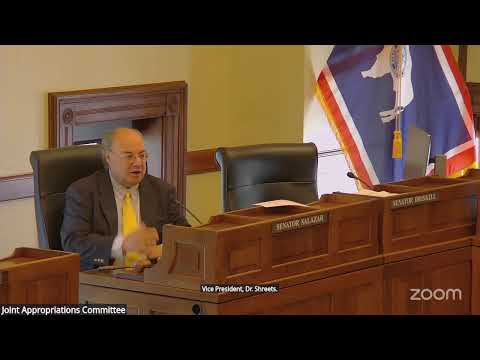
Committee debates county consensus funding bill, formulas and special‑district eligibility
Summary
LSO presented draft 27LSO41 to create a county consensus funding program administered by OSLI: proposed distribution is 75% by three‑year rolling population average and 25% by inverse assessed valuation; counties must reach consensus with their commissioners and a majority of incorporated municipalities to receive funds.
The committee reviewed 27LSO41, a draft to codify a county consensus funding program that would distribute state appropriations to counties for capital projects and major maintenance.
LSO staff explained the distribution formula — 75 percent of a county allocation based on a three‑year rolling average of population and 25 percent based on an inverse assessed valuation formula to benefit lower‑wealth counties. The draft requires a county board of commissioners plus the governing bodies of not less than 50 percent of incorporated cities and towns to agree on a prioritized list of projects before OSLI will release funds. LSO described eligible uses as capital projects, major maintenance and equipment integral to public services.
Members debated whether funds should revert if a county fails to reach consensus, whether a county's allocation should carry over until a project is ready, and whether special districts (fire districts, sewer districts, irrigation entities) should be eligible. Minerals committee staff indicated a companion funding proposal in that committee contemplates a large ongoing appropriation (staff referenced $100,000,000 in discussion). Several witnesses argued the program is vital for small communities that use county consensus money as match and that a four‑year encumbrance limit could be problematic for larger projects.
AI generated
The text on this page is AI generated. Summaries, highlights, analysis, and video transcripts are all produced from the original source material.
AI can make mistakes, so if you spot one, and we will fix it for everyone.
Note: the source content is unaltered by us. Any content source we link to, be it a video, an audio recording, or a document, is presented exactly as its publisher released it. That publisher is usually a government body, sometimes an individual official or another organisation.