Get Full Government Meeting Transcripts, Videos, & Alerts Forever!
Get email alerts on the City Infrastructure topic
No spam. Unsubscribe anytime.
San Marino outlines capital projects to improve sidewalks, streets, sewers, parks and emergency equipment
Summary
At a joint meeting with the school board, San Marino city officials reviewed recent and upcoming capital projects intended to improve pedestrian safety, road conditions, sewer reliability, playgrounds and fire apparatus, and described funding sources and timelines for each.
San Marino city officials used a joint meeting with the San Marino Unified School District to summarize multiple capital projects they say will improve safety and accessibility for students and the community.
The council described completed and planned work on sidewalks and curb ramps, a major street resurfacing cycle, upgrades to three sewer lift stations, a planned replacement of a reserve fire engine, and a phased replacement of the Lacey Park playground. City presenters emphasized connections between the projects and safer routes to schools.
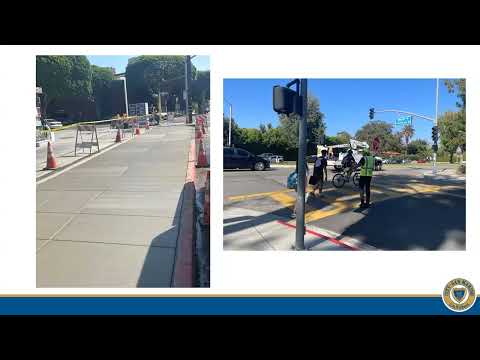
City Council member John Chow said the fiscal 2025–26 sidewalk cycle included 8,665 square feet of new sidewalk on Mission Street and related curb-and-gutter work near Valentine Elementary School and Huntington Middle School; he said the city replaced more than 33,400 square feet of sidewalk citywide in the most recent cycle (roughly 1.6 miles). City staff said sidewalks projects are funded from the city general fund, the Transportation Development Act, and, in certain years, Community Development Block Grant funds reserved for ADA-compliant curb ramps. The city said a typical construction window after scheduling is about six weeks and that future cycles are subject to budget availability.
Council members also described a street resurfacing cycle completed in May that covered about 4.5 miles of roadway at a cost the city described as more than $7.5 million. The resurfacing program is paid from a mix of the general fund, gas tax, Proposition C, and regional transportation measures (county measures R and M) and has used a CalRecycle rubberized-asphalt grant for sections that employ rubberized asphalt. City staff said the design phase typically takes six months, bidding and approvals one to two months, and construction another six months.
Council member Lowe briefed the boards on a sewer lift station renewal program. The city said upgrades to the Orlando Road lift station are complete, work is under way at the Monterey Road station, and Avondale Station is next. The combined effort is described as a near $2.3 million, one-time investment funded from the city general fund; officials said individual station phases take roughly three to four months and that contractors replace lift stations one at a time to preserve system redundancy.
On public-safety equipment, the council described plans to replace reserve fire engine 791. Officials said the department received a 2024 quote and production timeline from the manufacturer and that rising prices and long lead times motivated earlier ordering. The city reported a total estimated cost of about $1.25 million for the apparatus, with $450,000 appropriated in the fiscal 2025–26 budget; the remaining $800,000 would need to be appropriated in a future budget for an order expected in fiscal 2026–27. The vendor warned production could take up to 48 months; the city noted it follows a 10‑year schedule for frontline engines and a 20‑year schedule for reserve engines.
Council members also described a multiyear phased replacement of Lacey Park’s playground. The city said phase 1 (play structure for ages 5–12 and a new swing set) is complete, phase 2 (play structure for ages 2–5) began in September with an anticipated ribbon cutting the following month, and later phases could replace playground surfacing and add site furnishings. The city reported a $1.1 million total project cost to be funded through the general fund and community donations, including contributions from Rotary Charities and the Paul Eleph Memorial Fund; staff said the city used a public input exercise at a 2024 community event to help select the new play-structure design.
City presenters repeatedly framed these projects as investments that reduce long-term maintenance costs and improve safety for students walking and biking to school. No formal votes or motions were recorded in the meeting transcript for these agenda items; speakers described prior appropriations (for example, the $450,000 budget appropriation toward the fire engine) or future steps such as issuing requests for proposals for design work.
The city framed timelines and next steps as subject to budget availability, vendor lead times and routine competitive bidding. Officials said the city will continue to coordinate project schedules around school activities to limit disruption.
Details and clarifications
- Sidewalks: 33,400 square feet replaced in the most recent cycle (about 1.6 miles); 8,665 square feet added along Mission Street; construction typically ~6 weeks per project. - Street resurfacing: approximately 4.5 miles resurfaced in the latest cycle; cost described as over $7.5 million; design ~6 months, bidding/approval 1–2 months, construction ~6 months. - Sewer lift stations: upgrades to Orlando Road complete; Monterey Road in progress; Avondale next; combined near $2.3 million cost; phases ~3–4 months each. - Fire engine replacement: estimated total $1,250,000; $450,000 appropriated in FY 2025–26; vendor production could take up to 48 months; replacement cycles are 10 years for frontline engines and 20 years for reserve engines. - Lacey Park playground: $1.1 million total project cost; phase 1 complete, phase 2 under construction with expected completion next month; funded by general fund and donations (Rotary Charities, Paul Eleph Memorial Fund).
Next steps: city staff and council said they will continue design work, issue RFPs for future projects as budgets allow, and coordinate construction schedules around school activities to limit impacts to students and families.