Lifetime Citizen Portal Access — AI Briefings, Alerts & Unlimited Follows
St. Pete Beach neighborhood and city staff outline $28–30 million resiliency plan, request design funds
Loading...
Summary
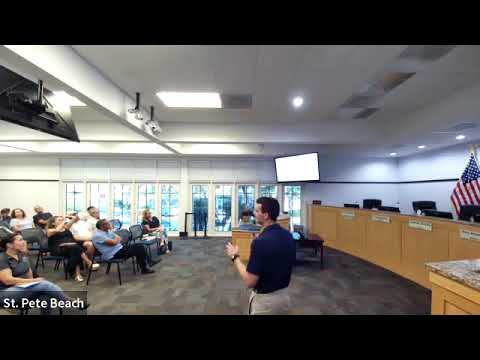
City staff and Don CeSar Place residents met to discuss repeated tidal and rainfall flooding, temporary pump deployments and a proposed neighborhood resiliency program that staff estimated at roughly $28–30 million and said would require FY2026 design funds.
City staff and Don CeSar Place residents met to discuss repeated tidal and rainfall flooding, short‑term responses and a proposed neighborhoodwide resiliency plan that staff estimated at roughly $28,000,000–$30,000,000 and said would require design funding in the next fiscal year. Camden, a city stormwater staffer, told residents the city will ask the City Commission to include design money in the FY2026 budget and to competitively procure an engineering firm to convert earlier concepts into construction‑ready designs.
The presentation and discussion focused on why Don CeSar Place floods and what the city can do next. Camden summarized recent events, saying that on Aug. 10 the area recorded “almost 4 inches of rain in just a 2‑hour period” during a high tide and that the neighborhood saw record rainfall on Aug. 23–24. “The city as a whole, our stormwater network is designed to handle a 25‑year storm event,” Camden said, explaining that a 25‑year event has about a 4 percent annual chance of occurring. He added that the combination of higher tides and intense rainfall causes the compounding flooding residents are experiencing.
City staff described several existing and planned measures. The city has deployed three portable pumps to problem locations (Camden identified sites at 30 Sixth Avenue, Don Jose and the Alfonso intersection) and is mobilizing them during storm season as a temporary measure. Staff said one seawall and street/drainage replacement at 30 Sixth Avenue is being treated as an emergency repair, with a vendor selected and material procurement underway and construction anticipated to start in September. Design and permitting were complete for two bid packages to modify five outfalls and relocate tie‑check valves into accessible vaults; staff said those solicitations will be advertised and construction could start in late fall or winter. A permeable asphalt contract for work near El Centro has been awarded and is scheduled to follow Don CeSar Hotel work, expected in November.
Camden described the longer‑term “resiliency adaptation” project that staff wants to advance into engineering: raising and retrofitting seawalls to a 5‑foot code elevation for a 2050 planning horizon, installing curb inlets and new drainage pipes, regrading streets in segments, and evaluating permanent pump stations with underground wet wells and submersible pumps. Staff’s planning‑level estimate for a comprehensive set of improvements north and south of the Bayway was about $28–30 million and would include public and private shoreline work, pumps and underground drainage. Camden said the project will require coordination with multiple stakeholders, notably the Florida Department of Transportation for infrastructure that ties into FDOT’s Bayway and Gulf Boulevard drainage.
Residents pressed the city on sequencing, property impacts and code changes. Several homeowners asked whether the city will allow structural fill and higher finished floor elevations during rebuilding; staff said the land development code currently restricts structural fill but that the city is preparing land‑development code changes to allow structural fill and other engineering standards, with the code update proposed for a fiscal year after next. Camden and other staff cautioned that raising individual lots without a coordinated neighborhood approach can cause adverse impacts and noted the city and residents will need basin‑by‑basin consensus on design goals — for example, whether to plan to a 2040 or 2050 horizon and whether roads should be expected to see some flooding.
Staff also reviewed administrative and maintenance items: the seawall ordinance includes a variance process where a licensed marine engineer can certify alternative elevations when site constraints prevent meeting a 5‑foot standard; the operations budget proposal includes a $500,000 line item for stormwater repair and maintenance to address outfalls, baffle boxes, inlet covers and tie‑check valve replacements; and the city’s prior debris removals after storms followed FEMA reimbursement procedures, which require documented staging and pickup. Camden said the neighborhood has formed a resiliency committee and that staff will hold basin‑level workshops and community surveys to reach local consensus before final design procurement.
Kathy Garsha, recording secretary for the neighborhood property owners corporation and the neighborhood’s resiliency volunteer coordinator, encouraged resident participation in the committee and said the group will coordinate outreach and report back to the city. Frances, the city manager, attended and said staff will continue outreach and follow up on residents’ requests for historical FDOT plans and on specific inlet and outfall repairs.
No formal City Commission vote occurred at the meeting; staff said the next formal step is to present a design‑funding request to the City Commission as part of the FY2026 budget process. Camden and staff listed the immediate operational items they control (portable pumps, emergency seawall repair at 30 Sixth Avenue, awarded permeable asphalt work) and said the larger resiliency adaptation project is contingent on design funding, permit approvals and coordination with FDOT and state environmental permits.
Residents were invited to sign up for basin‑level workshops and to join the neighborhood resiliency committee; staff said it aims to return before year end and run multiple sessions early next year once an engineering firm is under contract.