Lifetime Citizen Portal Access — AI Briefings, Alerts & Unlimited Follows
Lawrence police outline community partnership plan, introduce school therapy dog and monthly performance reports
Loading...
Summary
Police Chief Rich Lockhart introduced Officer Lindsey Bishop and therapy dog Rosie, summarized a Department of Justice-facilitated Strengthening Police and Community Partnerships (SPCP) process that produced a community-led action council, and rolled out new monthly performance reports tracking calls, alternative responses and staffing.
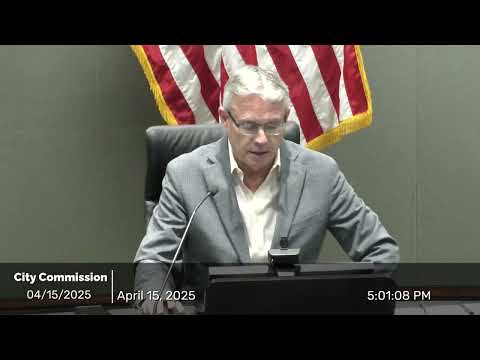
Chief Rich Lockhart gave the Lawrence City Commission a detailed update on public safety programs and data during a work session April 15, introducing Officer Lindsey Bishop and Rosie, a therapy dog assigned to school resource duties, outlining results from a Department of Justice-facilitated Strengthening Police and Community Partnerships process, and presenting the department's first monthly performance reports.
The update focused on three areas: community engagement (highlighted by Rosie’s role in schools and events), the SPCP community process and council that grew from it, and newly published monthly performance metrics showing calls for service, alternative responses such as the mental health response team (MRT), and staffing levels. "She creates moments. She creates connections," Officer Lindsey Bishop said of Rosie, whom she and the department trained and certified for therapy work. "In a 3 minute passing period, the most I ever counted was 30. She had 30 contacts in a 3 minute period."
Why it matters: the report ties several initiatives the city has pursued — school resource officers, alternative response teams, and community engagement — to measurable work and a community-driven plan for next steps. The SPCP process, run with staff from the U.S. Department of Justice Community Relations Service, convened about 80 community members over two Saturdays to identify strengths, barriers and prioritized actions and produced a council to turn ideas into an implementation plan the city will track.
Lockhart summarized the SPCP findings and next steps. The process identified "them versus us" perceptions, gaps in transparency and accountability, mental-health response needs, cultural inclusivity concerns and mixed public messaging as top barriers. He said groups recommended co-developing policies and training with community input, expanding alternative responses for mental-health calls, and increasing non‑enforcement community engagement. Kelly Hans Pearson of the Department of Justice’s Community Relations Service trained neighborhood facilitators who led the sessions, and Doris Ricks helped organize local participation, Lockhart said.
The commission also received new monthly performance reports for January through March. Lockhart highlighted that calls for service fluctuate seasonally (6,600 in January, 7,400 in March) and that use of alternative responders has grown: the MRT logged 161 calls in March and 316 year to date. He said community service technicians handled 708 report-type calls in the first three months. Lockhart described a new ‘‘top five call‑location’’ metric that allowed staff to identify a single residence and an apartment complex generating repeated calls and to coordinate outreach with housing management and social services.
The reports also flagged operational challenges. Lockhart said the department had 143 sworn personnel on the roster of 152 authorized positions in March, but effective sworn staffing (officers available for duty after accounting for academy, field training and leaves) was 128. He described ongoing work to reduce gaps: improved dispatching of the MRT through emergency communications, on‑radio access for the teams, and efforts to standardize and publish more department data. On domestic‑violence response, Lockhart said partner referrals exceeded reported incidents for the month (106 percent) but that 36 percent of lethality assessments were not completed by responding officers — a shortfall the department plans to address through training and process changes.
Public comment reflected both support and sharp criticism. Officer Bishop’s work drew praise; several speakers asked that the department share more data and noted the value of alternative responses. Other commenters raised strong concerns about police accountability, body cameras, and past complaint handling; one speaker criticized department leadership and reporting practices during public comment.
Next steps and oversight: Lockhart said the newly formed SPCP council will develop a worksheet of actions, owners, resources and completion dates; the council will reconvene next month to begin implementation planning. He also said the department will deliver the monthly performance reports in the city manager’s report going forward so the commission and public can track progress. "When we make mistakes, we're gonna say we made mistakes and we're gonna fix what caused that mistake to happen and then we're gonna make sure that it doesn't happen," Lockhart told the commission.
Commissioners asked for benchmarks and suggested additional public messaging about the department’s work; staff said they are working with KU’s School of Journalism and other partners to produce explanatory materials and that they will compare selected KPIs to benchmark cities as the program matures.
Ending: The commission received the update and directed staff to return with the SPCP council's implementation plan and future monthly performance reports.