Lifetime Citizen Portal Access — AI Briefings, Alerts & Unlimited Follows
Sudbury holds public outreach on Route 20 corridor study; residents flag sidewalks, rail-trail connections, flooding
Loading...
Summary
Planning staff and consultants held a public outreach meeting in Sudbury to gather local feedback on a study of the Route 20 (Boston Post Road) corridor, which runs about five miles between the Marlborough and Wayland town lines.
Planning staff and consultants held a public outreach meeting in Sudbury to gather local feedback on a study of the Route 20 (Boston Post Road) corridor, which runs about five miles between the Marlborough and Wayland town lines.
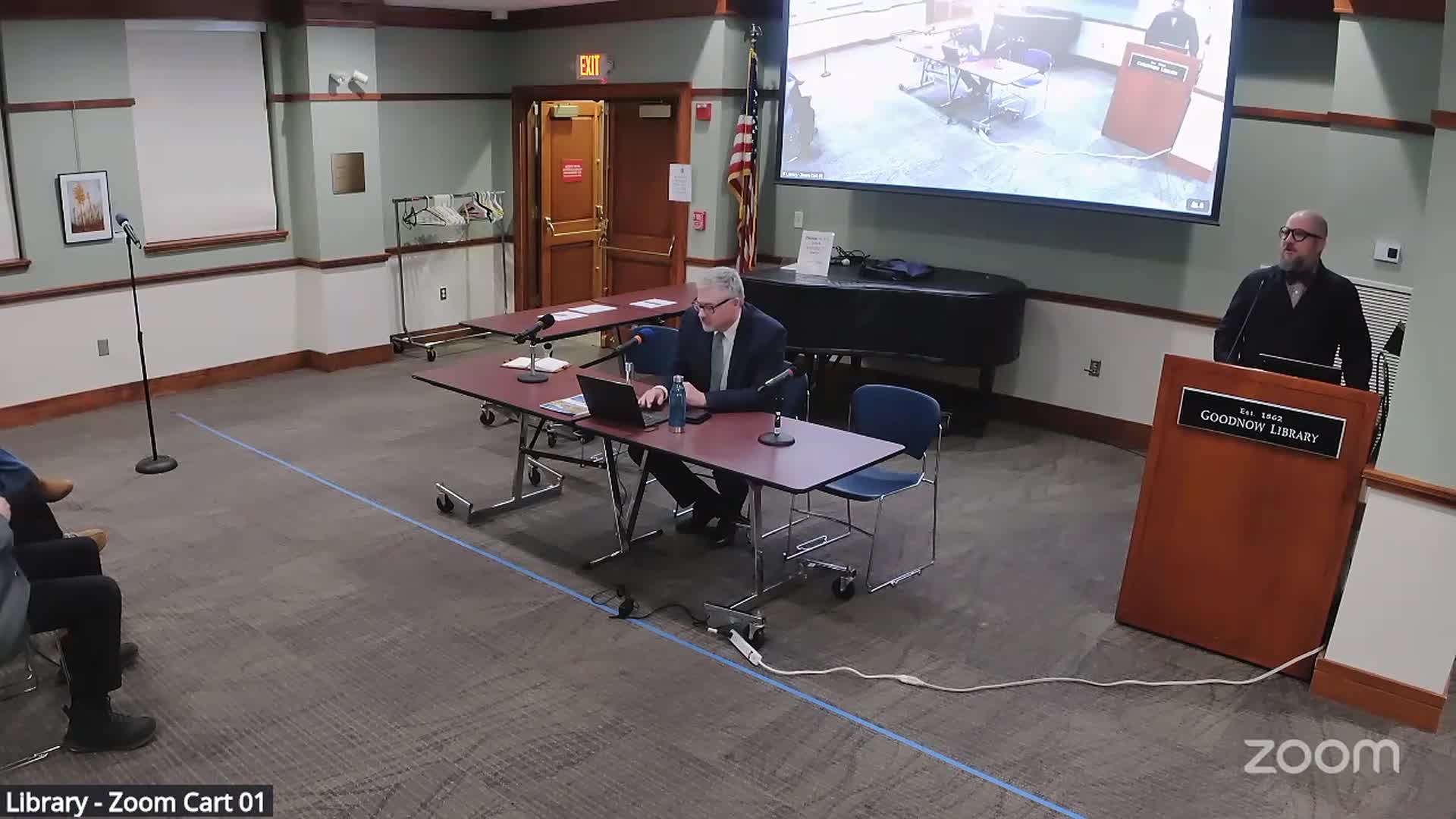
The meeting, led by Adam Birney, planning director for the Town of Sudbury, and Adam Deschano, a planner with the BSC Group, reviewed the study’s objectives, existing-condition mapping and next steps and then opened the floor to a SWOT (strengths, weaknesses, opportunities, threats) exercise and a sticky-dot mapping activity for residents and business owners.
The study area defined by the consultant includes parcels with frontage on Route 20 and adjacent properties the team considered integral to the corridor’s function, including Meadowlark, Chiswick Park, the Wayside Inn area and parcels east of Union Avenue. Consultants said the right-of-way and roadway are controlled by the Massachusetts Department of Transportation (MassDOT) and that any changes within the right-of-way would require MassDOT approval. They noted that properties along the corridor use septic systems or private wastewater treatment plants and that about 75% of the corridor sits within a water-resource protection overlay district.
Why it matters: Route 20 is Sudbury’s primary east–west corridor and a regional connector. The corridor study is an action item in Sudbury’s 2021 master plan and is intended to produce a vision and an economic-development road map that could inform zoning and streetscape changes, housing recommendations and climate-resilience measures. The planning department expects a draft report to the town in late June and will return to the Planning Board in April and to the Select Board in May for further briefings.
What residents and stakeholders raised: The public comment period and the facilitated SWOT exercise repeatedly emphasized a small set of issues:
- Pedestrian and bicycle safety and continuity: multiple speakers noted that sidewalks are intermittent or in need of repairs and that there is no complete sidewalk network across the corridor. A resident said existing sidewalks are a “strength” but also a weakness because they are incomplete. Several commenters urged safe bike lanes and improved crosswalks, especially near shopping plazas and the Mill Village area.
- Rail-trail crossings and access: commenters called the two rail-trail projects that intersect the corridor (including the Mass Central Rail Trail connections and the southern extension of the Bruce Freeman Rail Trail) both a strength and an immediate planning need: residents urged clear, safe crossing designs where trails cross Route 20 and asked about timing and whether signalized crossings would be installed.
- Traffic flow, cut-throughs and trucks: speakers described Route 20 as heavily used by through-traffic and trucks and said that cut-through speeds affect adjacent neighborhoods (for example, the King Philip area). Some participants recommended synchronized traffic signals during rush hour and improved lateral access between plazas to reduce trips onto Route 20.
- Water resources, wetlands and climate risk: consultants and residents flagged water-resource restrictions, flood-prone areas and the presence of wellhead protection zones. One commenter named Hager Pond Dam as a localized climate-related threat at the western end of town. Several residents warned that wetlands and groundwater protections will constrain redevelopment, sewer expansion and access-road options.
- Placemaking and economic mix: residents suggested making individual shopping areas feel like small “villages” with improved streetscape, lighting and building-front orientation to capture pass-through traffic and support local businesses. Concerns were raised about vacancies, rising rents, homogenization by national chains and the changing economics of brick-and-mortar retail.
- Opportunities for green infrastructure and renewable energy: multiple participants proposed reuse of large parking areas for solar canopies, better lighting (including solar lighting), and stormwater capture measures in low-lying spots.
Process notes and next steps: Deschano outlined work completed to date: site visits, mapping of land use and water resources, an inventory of businesses, interviews with town staff and outreach to roughly 30 property owners and businesses. He described an upcoming sticky-dot mapping activity to capture geographically specific feedback and said the consultant team will incorporate the meeting input into the study deliverable scheduled for late June. The team will present interim findings to the Planning Board in April and to the Select Board in May.
Attributions: direct quotations in this piece come from meeting remarks made on the record. For example, Adam Birney introduced the meeting as planning staff outreach; Adam Deschano described the study scope and schedule. On the public record, a Zoom commenter said, “Sudbury has recently become a certified local government, certified through the Mass Historical Commission,” a point raised as a possible source for historic-preservation funding.
No formal decisions or votes were taken at the meeting; the session was an outreach and information-gathering event and included interactive public exercises rather than ordinance or bylaw actions.
Ending: The study team encouraged attendees to use the sticky-dot boards, sign the attendance sheet and contact planning staff with additional comments. The consultant expects to deliver a report to the town in late June and to brief the Planning Board and Select Board in the spring.