Get Full Government Meeting Transcripts, Videos, & Alerts Forever!
Get email alerts on the Workforce Development topic
No spam. Unsubscribe anytime.
Alaska pilot expands ‘career guides’ to link students with jobs as state grapples with labor shortfalls
Summary
A Juneau "lunch and learn" hosted by Sen. Kelly Merrick highlighted a new cross‑industry workforce plan and a pilot to expand career guides — staff who connect students to training, apprenticeships and employers — as Alaska faces declining working‑age population and industry labor gaps.
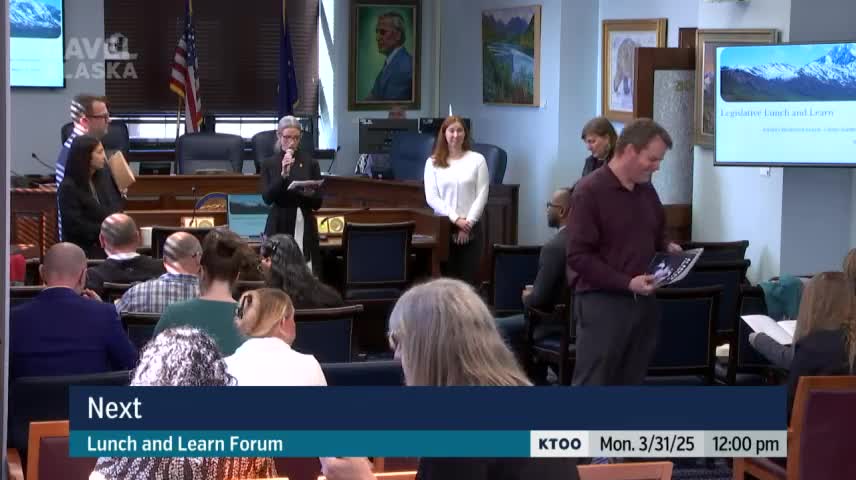
Sen. Kelly Merrick, an Alaska state senator representing Chugiak‑Eagle River, hosted a lunch‑and‑learn in Juneau about “Alaska’s workforce future,” where state and regional education and labor officials described a pilot program that places trained career guides in schools and job centers to connect students with training and employers.
Mariko Selle, executive director of the Alaska Workforce Alliance, said the cross‑industry workforce plan — developed with the Alaska Department of Labor and Workforce Development and funded by the Denali Commission — centers on six strategies, including career awareness, skills development and regional workforce development. “We are in a real workforce pickle here in Alaska,” Selle said, adding that the state faces a declining working‑age population while demand grows in infrastructure, energy and health care.
The career guides pilot places staff in school and job‑center settings to help students develop post‑high‑school plans, enroll in postsecondary programs, pursue apprenticeships, or enter the workforce. Jose Owens, operations manager for American Marine Corporation and a member of the plan’s industry advisory committee, told the group that employers often prefer to hire Alaskans and that career guides could help channel youth into jobs such as welding, diving and vessel maintenance. “Training is not cheap. But I want to invest in and grow with them,” Owens said.
Speakers described several local pilots. The Bristol Bay Regional Career and Technical Education (BBRCTE) program deployed career guides across 22 high schools and about a hundred students in 11 classes; its director, Zack Stinson, said early results were mixed and underscored the need for structure, data and stronger links to apprenticeships and unions. Stinson noted partnerships with unions and tribal entities to create apprenticeship pathways.
Sealaska Heritage Institute’s education director, Christie Ford, said her organization is building culturally affirming curricula and a 0.5‑semester work‑readiness course that can be offered in Southeast school districts. Ford said career guidance should respect students’ cultural identities and local motivations rather than push a single postsecondary path.
Emily Ferry of the Association of Alaska School Boards said statewide measures show Alaska has one of the lowest postsecondary enrollment rates in the nation and one of the highest rates of disconnected youth (ages 16–24). Ferry cited a Bethel Regional High School example from 2016 in which local career guidance produced a 65% postsecondary enrollment rate for that cohort, compared with about half that rate statewide at the time.
University of Alaska associate vice president Terry Coughlin and other panelists said sustainability is a central concern: pilots that produce gains when grant funding exists can decline once funding ends. The working group described plans to survey existing programs, build a shared website linking AKCIS and other resources, and develop common data collection so the state can measure outcomes.
Panelists also discussed outreach to untapped populations. Paloma Harbor of the Department of Labor and Workforce Development said the department meets monthly with the Department of Corrections to provide pre‑release workshops in resume writing and to connect individuals to job center services. Monica Goyette, a project coordinator with the Department of Education, said the Rooted framework is being piloted in Alaska to help rural students plan and launch from high school into jobs, training, or the military.
Presenters did not advance formal legislative proposals at the event. Instead, they described implementation steps under way — regional pilots, alignment with AKCIS (Alaska’s Career Information System), data collection plans, and a working‑group survey — and invited legislators to request future updates.
The session closed with an invitation to follow the pilot’s progress; organizers said there was no formal ask at the meeting but that they would return to report implementation status and survey results.