Lifetime Citizen Portal Access — AI Briefings, Alerts & Unlimited Follows
Council committee approves $59.3 million first allocation for Choose How You Move transit program
Loading...
Summary
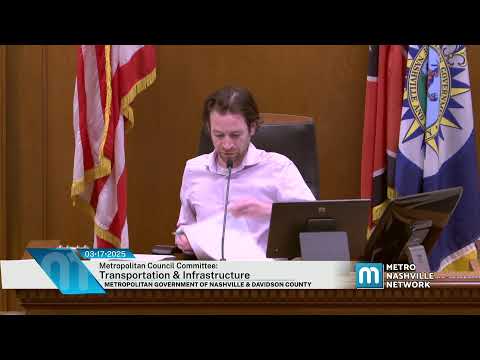
The Metropolitan Government of Nashville and Davidson County’s Transportation & Infrastructure Committee approved a $59.3 million appropriation on March 17 to begin implementing the Choose How You Move transportation program.
The Metropolitan Government of Nashville and Davidson County’s Transportation & Infrastructure Committee approved a $59.3 million appropriation on March 17 to begin implementing the Choose How You Move transportation program.
The committee voted 11-0 to appropriate $59,300,000 for operating and capital needs tied to the sales-tax-funded program, the committee chair said. The allocation funds initial operating support, a low-income fare subsidy program and capital projects including bus purchases and signal upgrades.
Why it matters: Choose How You Move is the city’s multi-year transit expansion program funded by a sales tax voters approved in November. The appropriation moves cash collected so far into specific operating and capital accounts and begins delivery of projects promised under the program.
Administration official Michael Briggs summarized the allocation for the committee, saying the package covers operating needs and early capital investments. “That amount is 59,300,000.0,” Briggs said. He told the committee the appropriation follows the council’s budget approval and the transit referendum, and that the tax collections began February 1.
The appropriation’s budgeted split is $43.135 million for operating purposes and $16.165 million for capital projects, according to Briggs.
Capital projects listed in the appropriation include the purchase of 12 new buses, a Murfreesboro Pike queue-jump lane, a West End curbside bus lane pilot (corrected in committee to run from Seventeenth to 20 Fifth Avenues), fiber installation to support signal upgrades for an estimated 592 traffic signals, planning for a South Broadway transit center, street improvements covering 39 miles of identified complete-streets projects, a new bus operations and maintenance facility, and continued design work on the Main Street/Gallatin Pike all-access corridor phase 1.
NDOT staff described how work will be prioritized. “We actually have an existing ITS plan that calls out priority corridors…we’ve actually started working through that with local dollars. Currently we’re installing on Nolensville Pike. Gallatin will be the next,” Derek Hagerty, a NDOT representative, said. NDOT said designs for some corridors are at 90 percent and this funding will complete design and enable concurrent construction across multiple corridors.
On street projects, Justin Cole, a program staffer working on the Choose How You Move list of complete-streets projects, said the first projects are those already underway through Vision Zero and the bikeway program, including work on Chestnut, Edge Hill and planning on East Thompson Lane.
Questions from councilmembers focused on transparency, timing, eligibility for low-income fare passes and the ITS staffing needed to implement the work. Amanda Deaton Moyer from the Department of Finance said the city had not yet received any sales-tax dollars because sales tax receipts are remitted two months in arrears; she said the administration expected roughly $11 million to $12 million per month, on average, but emphasized the department had not yet collected those funds and that figure was an estimate.
On the low-income fare subsidy, Michael Briggs said eligibility would be based on existing housing and nutrition assistance programs and that further details must be worked out. “It will essentially the parameters around it would be based on housing and nutrition assistance grama,” Briggs said. WeGo CEO Steve Bland described an administrative approach used in other cities: documentation of eligibility for other safety‑net programs. “Most cities that have done this…they’re just looking for some documentation of eligibility for other programs,” Bland said. He said a working group of agencies and advocacy groups will develop program parameters.
Bland and administration staff said the plan is to use WeGo’s existing QuickTicket platform for distribution, and that once partners agree on program parameters the fare pass could be implemented quickly. “We should easily be able to do it within 30 to 60 days of…everybody coming to consensus,” Bland said, adding the program will undergo the city’s Title VI civil‑rights review before implementation.
Committee members pressed on administration capacity to manage the program. John Grippy, Metro chief information officer, said central ITS has already committed a large share of staff time to transportation initiatives and that additional staff are needed. “About 60%, 70% of their time is being handled around these transportation initiatives,” Grippy said. He confirmed the new positions tied to this appropriation will be primarily devoted to Choose How You Move work.
On technical design and the fiber plant, Hagerty said the build will be a mix of buried conduit and aerial fiber: downtown corridors will be buried, while some early installations will be aerial on poles, with plans to transition to buried conduit when larger corridor work proceeds. The department said it will size conduit to allow future capacity and flexibility.
The committee voted to approve the appropriation after roughly 45 minutes of discussion; the vote was 11 in favor, 0 opposed, 0 not voting.
The chair said the full Choose How You Move implementation team will return to a future committee meeting with a more comprehensive rollout update.
Ending note: Committee members asked for additional public outreach and earlier notice about how the initial $59.3 million would be spent; administration staff said they would provide more details as program parameters are finalized and as funding is received.