Get AI Briefings, Transcripts & Alerts on Local & National Government Meetings — Forever.
Lake Bluff consultant outlines stormwater testing, NPDES/MS4 duties; sampling steady, specifics to be shared
Loading...
Summary
A Baxter & Woodman engineer reviewed Lake Bluff’s responsibilities under Illinois’ NPDES/MS4 permit, described annual dry‑weather outfall inspections and four water‑quality sampling sites, and said recent samples have been broadly consistent year‑to‑year; staff will circulate historical graphs on measured parameters.
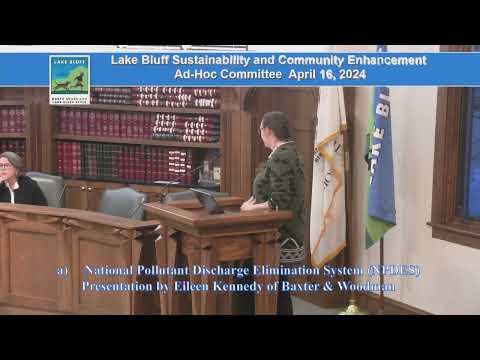
Eileen Kennedy, an engineer with Baxter & Woodman, told the Village of Lake Bluff Sustainability and Community Enhancement Ad Hoc Committee on March 18 that the village must follow Illinois Environmental Protection Agency rules under the National Pollutant Discharge Elimination System permit and the Municipal Separate Storm Sewer System (MS4) program.
Kennedy said the MS4 program requires public education, outfall inspections, water quality monitoring and program documentation, including a Stormwater Management Program Plan, a notice of intent submitted to the IEPA about program commitments (typically at permit renewal), and an annual report to IEPA. She said the village posts related materials on the Public Works pages of the Lake Bluff website.
The consultant said Lake Bluff samples four water‑quality locations annually — two on the Skokie River and two at Lake Michigan — and conducts outfall inspections in dry weather to detect illicit discharges, structural problems, and improper connections. The samples test for nutrients (including phosphorus), chlorides, dissolved oxygen, sediments and bacteriological indicators; Kennedy said labs follow standard operating protocols for analysis.
When asked whether Lake Bluff’s test results are trending worse or better, Kennedy said the measurements she has reviewed over recent years have been “pretty consistent year after year” and do not show “exorbitant amounts” or a clear worsening. She also said she would send a graph of accumulated parameter results to staff members Clara and Cheryl for distribution.
Audience members asked whether Lake Bluff tests for PFAS or microplastics. Kennedy said those are not part of the village’s standard parameter list and are not generally included in the current IEPA permit; she said PFAS testing can be difficult and that inclusion in future permits is possible but not currently guaranteed. Kennedy said the MS4 permit is in renewal and that the IEPA’s updates are expected but not guaranteed in any given year.
Kennedy emphasized that routine municipal activities — snow‑removal salts, roadway striping paint, vehicle wash solvents, landscaping runoff and lawn chemicals — commonly contribute pollutants carried by stormwater into Skokie River and Lake Michigan. She said staff receive annual training on best practices, including maintenance, de‑icing practices, illicit discharge recognition and spill response.
The committee asked for more data on which parameters the village can most influence (for example, lawn fertilizers and phosphorus); Kennedy agreed to provide historical graphs and sampling dates she has on file so the committee can prioritize outreach and education.
No formal committee action was taken on the presentation; committee members indicated they would review the distributed data and suggested staff continue public education and outreach tied to the MS4 program.