Lifetime Citizen Portal Access — AI Briefings, Alerts & Unlimited Follows
Working group adopts annual timeline for model family-violence policy, seeks clearer warrant, LAP and penalty language
Loading...
Summary
A Connecticut law-enforcement working group agreed Friday to adopt an annual timetable for revising the state model family-violence policy and directed staff to draft clearer language on serving arrest warrants, reassignment of domestic-violence cases when officers are unavailable, inclusion of the lethality assessment protocol (LAP), and clarifying when an order-of-protection violation can carry an enhanced felony charge.
A Connecticut law-enforcement working group agreed Friday to adopt an annual timetable for revising the state model family-violence policy and directed staff to draft clearer language on serving arrest warrants, reassignment of domestic-violence cases when officers are unavailable, inclusion of the lethality assessment protocol (LAP), and clarifying when an order-of-protection violation can carry an enhanced felony charge.
The change to the annual schedule is intended to align the committee’s product with the Police Officer Standards and Training (POST) council reporting cycle and the law-enforcement “red book” legal supplement, so policy text reflects legislative changes before publication. “So our goal as a subcommittee is to get a model policy with changes that we deem need to be made as a committee and approved by the full council,” Erin said, summarizing the amended timeline. She said the subcommittee would start substantive drafting in December, work through the legislative session, and present a final draft to the full council in August so it can be submitted to POST in time for the October 1 red-book update.
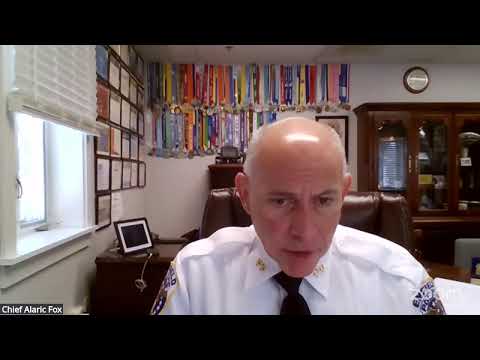
The timeline decision was presented as procedural rather than legislative: Alaric Fox, co-chair and chief of police in Enfield, said the annual submission would reduce the training burden on departments, noting that a department must train all officers on any new general order once POST adopts policy changes. “It’s Herculean from our perspective,” Fox said of repeatedly training more than 100 officers when policies change multiple times a year.
Warrants and reassignment: the panel asked staff to draft language to reduce the risk that approved arrest warrants “languish” after prosecutors return them to law enforcement. Gail Hardy, the chief state's attorney's designate, described recent improvements in the case-management system that allow prosecutors to log when a warrant was received, reviewed, corrected and returned to police; she said the remaining problem is ensuring consistent follow-through by police on serving those warrants. “Once they leave our offices, they go back to the police department and it’s thereafter the police department's responsibility to execute those warrants,” Hardy said.
Committee discussion focused on phrasing rather than a hard deadline. Several members warned against a fixed-day requirement because small departments have variable capacity and some cases require urgent, faster action. Chief Rob Rosato and Chief Fox both urged keeping a flexible standard such as "as soon as practicable" or "as soon as possible." Erin said the subcommittee would draft sample language and propose that departments include local procedures to address staffing gaps (for example, reassigning domestic-violence cases when an officer is on extended leave). “We should add that corrections from the prosecutor should also be done as soon as practicable,” Erin said.
Victim-advocate members pressed for clearer supervisory-level reassignment rules when officers are out long term. Merit LaJoy, complaint officer for the Office of the Victim Advocate, said victims frequently report that their cases stall when a single officer is unavailable and suggested language that would encourage or require case reassignment in extended absences. “We should not be putting these cases on the back burner if that particular officer is on vacation or out on workers' comp,” LaJoy said.
Inclusion of Connecticut LAP: the committee asked staff to add model language referencing the statewide Lethality Assessment Protocol, a screening tool for intimate-partner incidents that connects high-risk victims to services. Karen O’Connor, co-chair and CEO of the Network Against Domestic Abuse, proposed inserting LAP initiation criteria into the responding-officer responsibilities section and volunteered to draft suggested wording. “When intimate relationship is involved and you believe an assault has occurred, you sense the potential for danger is high and or the names of parties are repeat names and locations, or you simply believe it should be done,” O’Connor read from the LAP guidance and recommended mirroring it in the policy.
Orders-of-protection penalty language: committee members raised that the model policy does not clearly flag state law that elevates some protective-order violations to a higher felony level when the violation involves threats, restraint or assaultive behavior. Merit LaJoy said the enhancement enacted in 2014 is not being applied consistently: “Prosecutors are not catching this and neither are judges,” she said, noting she has seen warrants that list a violation of a protective order alongside an assault charge but do not reflect the enhanced penalty. Several members recommended the arrest-warrants and orders-of-protection subcommittee review how statutes are reflected in the model policy and propose clearer cross-references to the applicable Connecticut General Statutes (discussed in the meeting as Sections 53a-223 and related citations).
Next steps and votes: the group asked Erin, Fox and other staff to draft proposed language on (1) an annual submission cycle and hold-off of the December 2024 changes until the consolidated August submission; (2) warrant-service language using “as soon as practicable” plus a requirement that departments adopt local procedures for reassignment and expedited processing; (3) insertion of LAP initiation criteria into the responding-officer section; and (4) clarification of protective-order-related statutory citations. The arrest-warrants and orders-of-protection subcommittee was asked to take up the statutory-application question and report back.
On procedural votes, the committee approved the Oct. 29 meeting minutes; Merit LaJoy and Johanna Canning recorded abstentions. The meeting adjourned by motion at 12:07 p.m.
The subcommittee said it plans to present the draft language at the larger council session scheduled the following day and will reconvene as needed after the end of the legislative session to fold any public acts into the August submission to POST.