Lifetime Citizen Portal Access — AI Briefings, Alerts & Unlimited Follows
Oregon Health Authority outlines Health Policy & Analytics priorities, requests funding for market oversight and state-based marketplace
Loading...
Summary
At a Feb. 11 informational session on House Bill 5025, the Oregon Health Authority’s Health Policy and Analytics Division described data, affordability and workforce initiatives and requested funding for the Healthcare Market Oversight program and a state-based marketplace implementation.
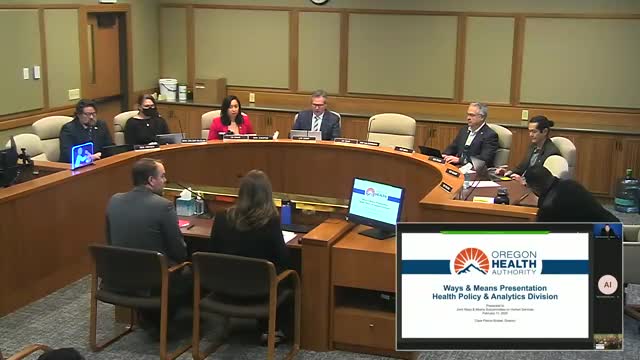
SALEM, Ore. — At a Feb. 11 joint Subcommittee on Human Services informational meeting on House Bill 5025, Claire Pierce Scribe, director of the Health Policy and Analytics (HPA) Division at the Oregon Health Authority (OHA), outlined HPA’s role in data-driven health policy, affordability efforts and workforce programs and presented two budget requests: ongoing support for the Healthcare Market Oversight program and funding to implement a state-based insurance marketplace.
HPA, Pierce Scribe said, works “to help achieve better health, better health outcomes, and lower cost for the state of Oregon.” The division supports data collection and analysis, policy design and program implementation across Medicaid, commercial markets, and state benefits programs, she told the subcommittee.
Why it matters: HPA supplies data and policy work used to set Medicaid rates, oversee coordinated care organizations (CCOs), measure statewide cost growth and design new coverage options. The division’s presentation tied its budget requests directly to OHA goals on coverage, affordability and equity and emphasized the use of data to target interventions and monitor cost drivers.
HPA’s examples and numbers included: an interactive Medicaid enrollment dashboard and CCO metrics dashboards; the All-Payer All-Claims database for cost and utilization transparency; the Patient-Centered Primary Care Home program, which HPA said has certified more than 600 practices (about three-quarters of Oregon’s primary care practices) and covers 94% of CCO members; and support for the Public Employees’ Benefit Board (PEBB) and Oregon Educator Benefit Board (OEBB), which provide benefits to roughly 300,000 state employees and dependents. Pierce Scribe said HPA’s work contributed to a record insured rate in Oregon — an estimated 97% — and that the OHP Bridge program (launched under House Bill 4035) now covers about 30,000 people who previously lacked coverage.
HPA highlighted two budget priority investment requests included in the governor’s budget package: POP 407 to fund the Healthcare Market Oversight (HCMO) program and POP 424 to complete the state-based eligibility and enrollment platform.
- Healthcare Market Oversight (POP 407): HPA described HCMO as the program that reviews proposed health care business transactions and sets conditions intended to protect cost, access, quality and equity. Pierce Scribe said transaction fees do not cover the full operating cost as transaction volume and legal complexity have increased; the budget request seeks general funds to support staff positions, community engagement and legal costs. HPA staff estimated the program currently uses roughly 10 full-time staff and supplements reviews with outside advisors for larger transactions, Claire Pierce Scribe said. HPA warned that without sustained funding the state’s ability to review and condition transactions could be limited.
- State-based marketplace implementation (POP 424): Under Senate Bill 972 (2023), Oregon must move from the federally facilitated marketplace to a state-based marketplace; HPA said it is on track for a Nov. 1, 2026 transition for plan year 2027. Pierce Scribe told the committee a state-based marketplace will provide real‑time demographic data that the federal platform does not, enabling more targeted outreach and better integration with REALD (race, ethnicity, language, disability) and SOGI (sexual orientation and gender identity) data collection.
HPA also laid out ongoing affordability work: the Cost Growth Target program, which HPA said is set at 3.4% annually and measures statewide health spending trends across Medicaid, Medicare and commercial markets; value‑based payment efforts to move away from fee‑for‑service; and programs that require CCOs to reinvest in social and health‑related services. The division noted workforce investments: a biennial workforce assessment and incentive programs that HPA said have provided incentives to more than 7,700 recipients since 2018.
Committee members asked technical and policy questions. Representative Pham asked whether wage increases are treated as acceptable reasons for cost growth; Pierce Scribe said the Cost Growth Target program considers wage growth and other acceptable factors and the annual report provides additional granularity. Representative Deal raised concerns about provider costs outpacing the target; Pierce Scribe reiterated that the program seeks to identify cost drivers and use transparency and multi‑stakeholder efforts to address them.
HPA staff also described the division’s funding mix. The governor’s request for HPA includes a mix of federal Medicaid reimbursement, other restricted fees (for example, marketplace and benefit board fees), limited lottery funds and a general fund request (HPA said general fund represents about 32% of its request). Pierce Scribe noted some revenue is restricted to specific purposes and cannot be flexibly used across programs.
No formal action or votes occurred during the informational meeting; committee members requested follow‑up on several items and HPA staff said they would provide additional information. The subcommittee adjourned after questions and comments.