Get AI Briefings, Transcripts & Alerts on Local & National Government Meetings — Forever.
Committee advances bill to define business location for in‑state tax sourcing; sponsors say bill prevents PO‑box abuses
Loading...
Summary
Members of the Arizona House Committee on Ways and Means voted to return House Bill 2118 with a due‑pass recommendation after debate over how to source certain in‑state transaction privilege tax (TPT) transactions and whether a post‑office box or server location can qualify as a seller—s business location.
Members of the Arizona House Committee on Ways and Means voted to return House Bill 2118 with a due‑pass recommendation after debate over how to source certain in‑state transaction privilege tax transactions and how cities and the Department of Revenue (DOR) interpret the current law.
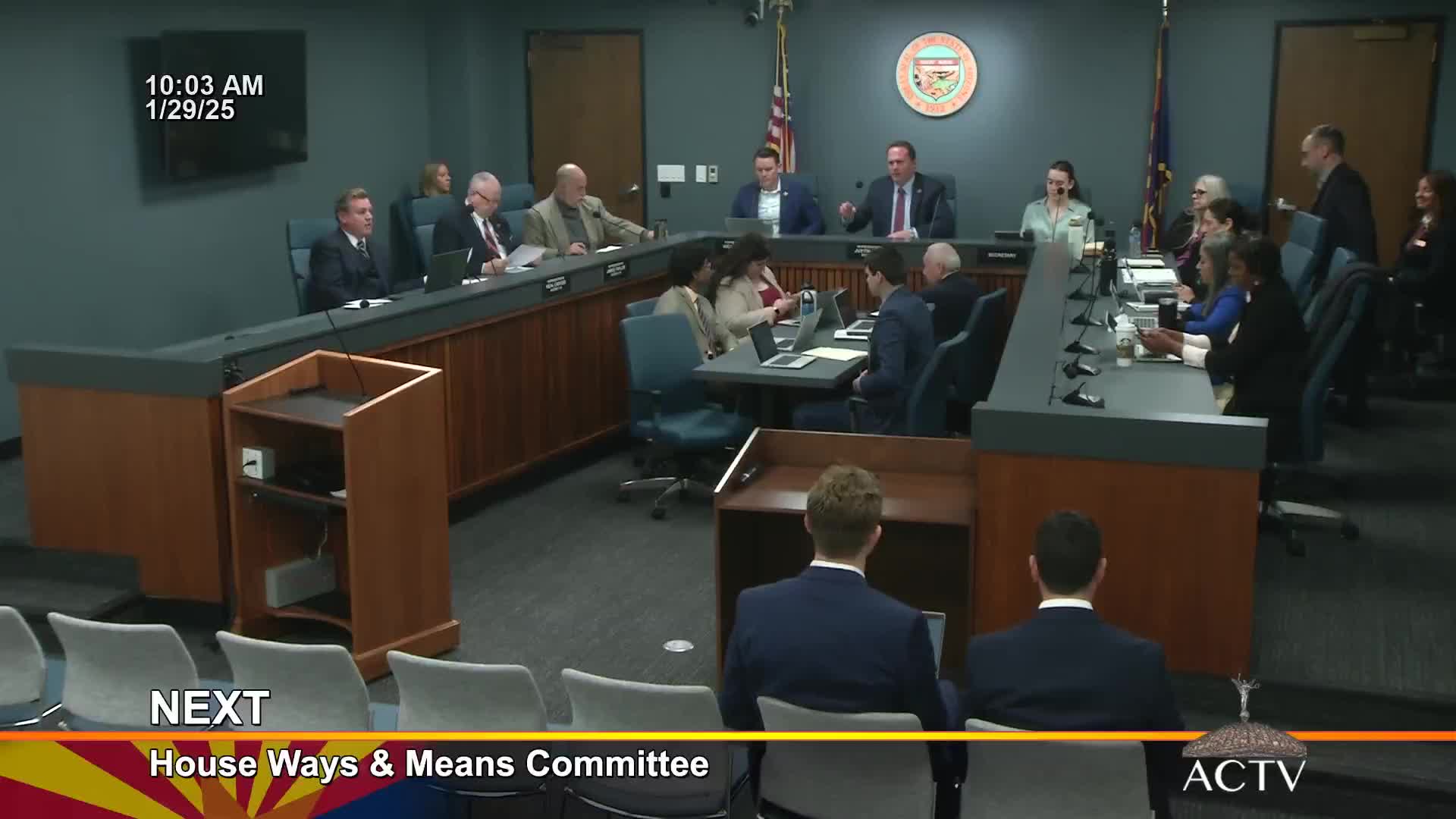
House Bill 2118, discussed and advanced in committee on Jan. 27, 2025, would define “business location” for purposes of sourcing taxable transactions and specify that the buyer—s place of residence, the location of servers used to transmit order information, or a post‑office box does not by itself determine where an order is received for sourcing purposes. The committee returned the bill with a due‑pass recommendation by a recorded vote of 6 ayes and 3 nays.
The change is intended to clarify an ambiguity that DOR officials and bill proponents said has led taxpayers, auditors and cities to different conclusions about where taxable sales must be reported. Vince Perez, Ways and Means analyst, summarized the measure for the committee: “House Bill 21/18 specifies that the location of servers does not determine where an order is received for purposes of sourcing certain transaction privilege tax transactions involving tangible personal property, and it also defines business location,” Perez said.
Representative Carter, the bill sponsor, told the committee the Department of Revenue had repeatedly asked for a statutory definition to prevent businesses from listing a post‑office box or other nominal address as their in‑state business location and to codify the department—s draft revenue ruling. “The Department of Revenue is worried that people will be, for example, using a post office box as a business location when it really isn't,” Representative Carter said.
Business and taxpayer groups testified mostly in support of the clarification. Kevin McCarthy, president of the Arizona Tax Research Association, told the committee the bill aims to stabilize sourcing rules for in‑state taxable sales and avoid a patchwork of city interpretations that could impose unpredictable audit liabilities on Arizona sellers. “The only thing worse than the payment of taxes is not knowing how much you really need to pay or who to pay this to,” McCarthy said.
Representatives of the League of Arizona Cities and Towns countered that the draft language could create complexity for online transactions and shift revenues among municipalities. Nick Ponder, testifying for the League, said the 2019 Wayfair‑era sourcing changes were designed to minimize administrative burdens on sellers and that the bill as written could produce unintended shifts of revenue toward jurisdictions that host distribution facilities. “If the online transaction was done and you were picking it up at the store, you pay taxes based on where you pick it up at, not at your home address. Simple as that,” Ponder said.
Chad Heinrich of the National Federation of Independent Business testified in support, saying the bill provides clarity that benefits small businesses and reduces the risk of surprise audits. Heinrich emphasized the measure applies to in‑state transactions and does not address out‑of‑state Wayfair sourcing rules.
Committee members raised lingering concerns about municipal revenue impacts. Several members said they supported clarifying that a PO box is not a business location but wanted further outreach with cities and DOR staff to minimize unintended consequences for jurisdictions that host large distribution centers.
The committee recorded its motion to return the bill with a due‑pass recommendation; the motion carried 6–3. The committee chair and members said they want DOR to remain engaged as the bill moves through the process.
Votes at a glance: House Bill 2118 — returned with a due‑pass recommendation (6 ayes, 3 nays).