Get AI Briefings, Transcripts & Alerts on Local & National Government Meetings — Forever.
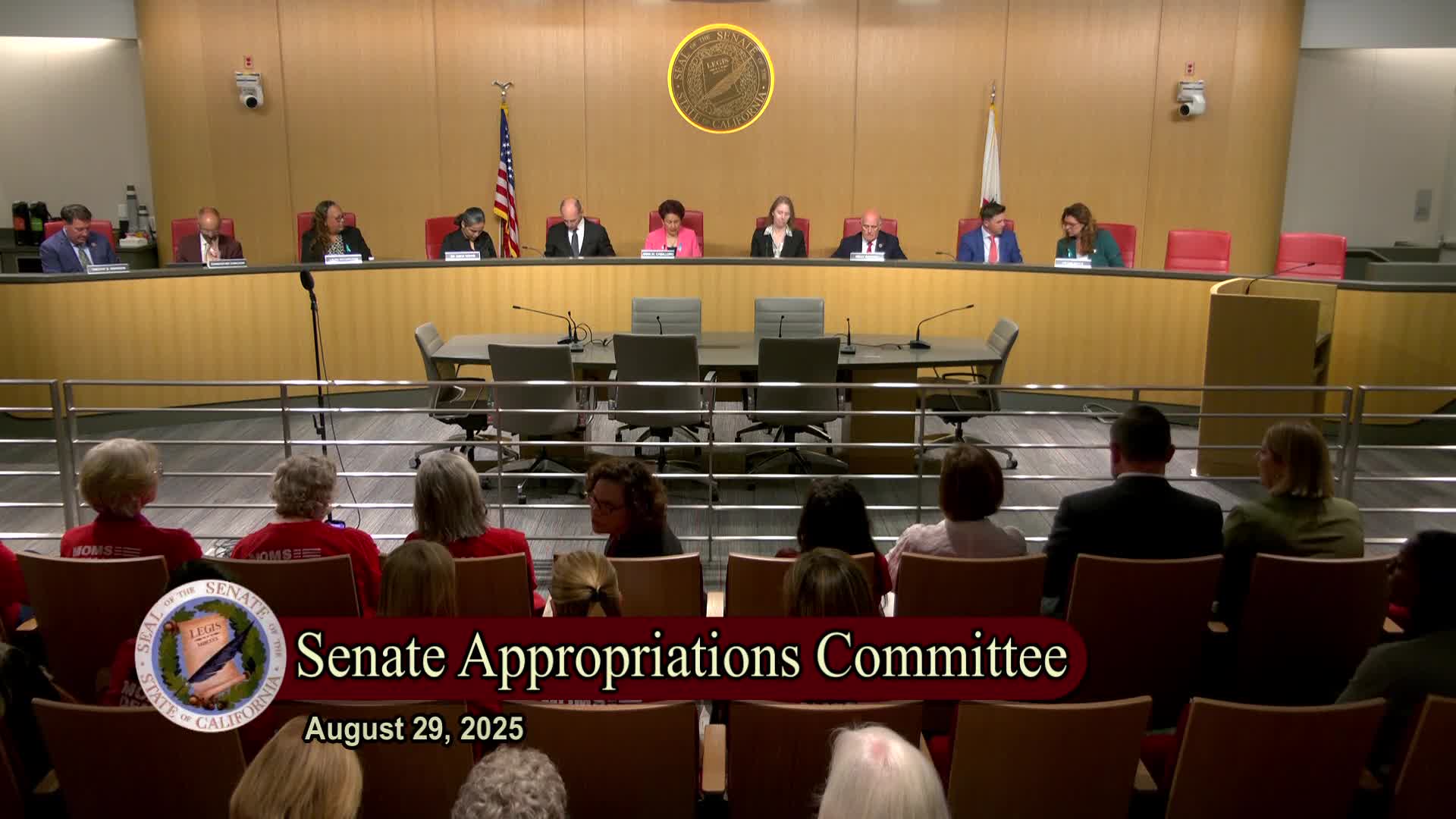
Senate Appropriations Committee advances dozens of Assembly bills in vote-only suspense-file hearing
Loading...
Summary
The Senate Committee on Appropriations held a vote-only suspense-file hearing and advanced numerous Assembly bills — many unanimously and several on 5–2 votes — while designating some measures as two-year bills for further work.
The Senate Committee on Appropriations convened a vote-only suspense-file hearing and advanced dozens of Assembly bills, with many measures approved unanimously and several passing on 5–2 or similar margins.
The committee chair said the hearing covers only items on the suspense file and that the session would be conducted as votes only, with no public testimony. “As noted in the daily file, the suspense file hearing is a vote only hearing with no testimony,” the chair said at the start of the session.
Why it matters: The committee’s action moves scores of Assembly bills forward in the legislative process and records fiscal recommendations and amended language for measures with budget implications. Some bills were held for further work as two‑year measures, preserving committee consideration in the next legislative year.
Most important facts
- The hearing was conducted alphabetically by author and focused on measures already heard by the committee; members were voting to advance or hold measures on the committee’s suspense file. The chair announced that advancing an item from appropriations does not guarantee a floor vote in its present form.
- Many bills were approved unanimously (recorded by the chair as 7–0), including measures on subjects such as the CalABLE program; teacher exchange programs; certain health, safety and environmental measures; and multiple technical or chaptering-cleanup items. Several bills passed on narrower margins, typically recorded as 5–2 with the minority caucus voting no on those items.
- The committee identified a subset of measures as two-year bills. The chair explained that designation preserves a bill for further negotiation and refinement rather than treating it as effectively dead in committee.
Votes at a glance (selected items; vote totals as read into the record)
- AB 560 (special education student-to-teacher ratio) — Do pass as amended per the author; reported out 6–1.
- AB 1076 (daily file substitution reference used repeatedly in roll calls) — multiple items substituted to the AB 10 76 roll call; numerous bills recorded as approved 7–0 when that substitution was applied.
- AB 1076-substituted examples recorded 7–0: AB 1076 substitution used for AB 1076/CalABLE-related items and multiple technical bills (recorded unanimous 7–0 where noted in the record).
- AB 137 (example: farmworker benefits, AB 1336 in record formatting) — Do pass as amended per the author; recorded 5–2.
- AB 332 (autonomous vehicles, as listed) — Do pass; recorded 5–2.
- AB 250 (statute of limitations amendment) — Do pass as amended per the author; recorded 5–2.
- AB 280 (reproductive health care provisions) — Do pass; recorded 5–2.
- AB 445 (alcoholic beverage licenses, County of Colusa) — Do pass as amended; recorded 7–0.
- AB 506 (contracts, sales of dogs and cats) — Do pass; recorded 7–0.
- AB 920 (example health‑provider credential streamlining, as recorded) — Do pass as amended; recorded 5–0 (where individual roll call and abstentions were read and then tallied).
(Notes: the hearing record consists largely of roll-call tallies read into the record; the chair frequently said “we’re going to substitute the roll call from AB 10 76” when applying a previously recorded roll. For many items the committee clerk read an individual roll call with members identified as voting “aye,” “no,” or “not voting,” and the chair announced the final tally. A full bill list and each measure’s posted roll‑call result are available on the committee’s website, as the chair announced.)
What the committee said and directed
- The chair emphasized that any member’s committee vote does not necessarily predict that member’s vote on the Senate floor. “Any of us vote for an item in committee today does not mean that that particular member is necessarily gonna vote for the item on the floor,” the chair said.
- For bills amended in committee, the chair said analysts would post addendum analyses with summaries of amendments and revised fiscal impacts within about an hour of the hearing’s conclusion.
Context and background
- A “suspense-file” hearing in the appropriations committee is used to handle measures with fiscal impacts; the committee votes only to move bills forward or hold them, normally without additional public testimony when those bills have already been heard.
- The hearing record shows many subject areas handled in bulk: health care, public safety, housing and land-use technical fixes, environmental and natural‑resources bills, and various administrative or conforming amendments.
Ending
The chair closed the hearing after announcing the final roll-call items and thanking staff and members for their work. Committee results were posted and are available on the Senate Appropriations Committee website, which the chair cited for the public to consult for complete roll-call tallies and addendum analyses for amended measures.