Lifetime Citizen Portal Access — AI Briefings, Alerts & Unlimited Follows
Hearing on bill to let CRIM retroactively tax abandoned properties to last utility bill draws broad municipal support
Loading...
Summary
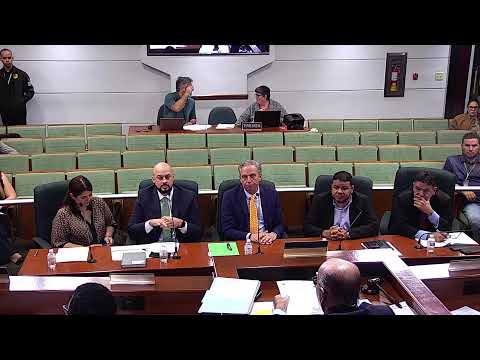
A House committee on Sept. 17 heard testimony on Senate Project 456, a measure to amend Article 7.041 of Law 107-2020 (Código Municipal de Puerto Rico) to allow the Centro de Recaudación de Ingresos Municipales (CRIM) to make the imposition, notification and collection of property taxes on abandoned properties retroactive to the full period of abandonment as determined by the last water or electric bill.
A House committee on Sept. 17 heard testimony on Senate Project 456, a measure to amend Article 7.041 of Law 107-2020 (Código Municipal de Puerto Rico) to allow the Centro de Recaudación de Ingresos Municipales (CRIM) to make the imposition, notification and collection of property taxes on abandoned properties retroactive to the full period of abandonment as determined by the last water or electric bill.
The proposal, presented at the request of Mayor Juan Carlos García Padilla of Coamo and introduced in the Senate by President Tomás Rivera Schatz, was described by supporters as a tool to help municipalities repossess and rehabilitate long-vacant lots for housing and commercial reuse.
Mayor Juan Carlos García Padilla, mayor of Coamo, told the committee the change would put municipalities “in a better position” to reclaim abandoned parcels and make them available to first-time buyers and developers. “Lo que estamos pidiendo es que esta propiedad... se retrotraiga la contribución al último año que podamos identificar que estuvo en uso, que es la factura del uso agua,” García Padilla said.
Why it matters: Backers said the bill would let municipalities recover revenue tied up in long-abandoned properties and reduce incentives to leave properties fallow, supporting rehabilitation and new housing development. Speakers said the change could affect tens of thousands of vacant lots across Puerto Rico and alter municipal balance sheets when properties are repossessed.
Support from municipalities and CRIM
The federation and association of mayors endorsed the measure. Ángel Morales, director ejecutivo of the Federación de Alcaldes, and Verónica Rodríguez Irizarri, executive director of the Asociación de Alcaldes, both told the committee they backed the bill’s core change to let retroactivity extend to the last utility service record when a parcel has been declared an estorbo público (public nuisance) after due process. “La asociación de alcaldes endosa este proyecto,” Rodríguez Irizarri said.
CRIM representatives said they did not object to the proposal as presented. Pedro J. Quiñones (CRIM representative) told the committee the agency can implement the change for properties declared public nuisances, and Javier García, subdirector of CRIM’s legal division, said CRIM has tools such as title searches, virtual appraisals and satellite imagery to identify and value properties at scale.
Points of contention and implementation questions
Lawmakers pressed several implementation issues. Committee members asked how abandonment would be defined in practice and whether the clause should apply only after a municipal declaration of estorbo público. Representatives and witnesses generally agreed that tying retroactivity to properties formally declared estorbo público (after the due-process procedures set out in the municipal code) would provide legal certainty.
Members also questioned the bill’s treatment of properties “in use.” The bill as amended in the Senate removed language proposing a two-year retroactivity cap for properties in use; several speakers said that change was acceptable but flagged the need for further discussion on protections for bona fide owners and for transactions where banks or purchasers already settle outstanding liabilities at closing.
Committee members explored operational details CRIM would use to determine abandonment, including: - title and public-record searches to identify last recorded owners; - requests to water utilities and LUMA for the last service bill or account activity; - satellite imagery and municipal permit records to confirm the timing of improvements; - procedures when a family member or occupant has reconnected utilities, and how that affects the abandonment timeline.
Witnesses said practices exist to distinguish bona fide occupancy (which would stop an estorbo public process) from abandoned parcels. García Padilla and CRIM witnesses described regular steps used in municipal cases: title studies, CRIM review, certification requests to aqueduct/electric authorities and two public edicts as part of the estorbo público process.
Protections and human-service concerns
Lawmakers and mayors raised scenarios involving elderly residents or heirs with limited capacity. Witnesses said municipalities must address human-service needs before beginning an estorbo público proceeding and that the administrative process includes safeguards to pause or redirect cases when a person in residence or a vulnerable adult is involved.
Fiscal and administrative capacity
Several legislators asked about CRIM’s capacity to process a larger universe of retroactivity claims and about potential fiscal impacts from changing retroactivity windows. Witnesses said CRIM is preparing a work plan with municipalities and can use virtual appraisals and data-matching tools to handle volume, but they acknowledged staffing and coordination needs. Representatives noted that the Financial Oversight and Management Board (junta de control fiscal) may need to be consulted where changes affect municipal receipts.
No formal vote recorded
The hearing ended with lawmakers thanking witnesses; committee members did not record a vote or adopt final text during the session. The project was presented to the committee as having been filed March 27, 2025, and proponents said it aims to expedite reuse of vacant lots and strengthen municipal fiscal positions.
Ending
Committee members asked the CRIM and municipal representatives to continue technical consultations on definitions, procedural language and operational capacity before any final vote. The hearing record closed at approximately 11:07 a.m.