Lifetime Citizen Portal Access — AI Briefings, Alerts & Unlimited Follows
Charlotte zoning panel hears contentious rezonings, residents press for traffic and school impact details
Loading...
Summary
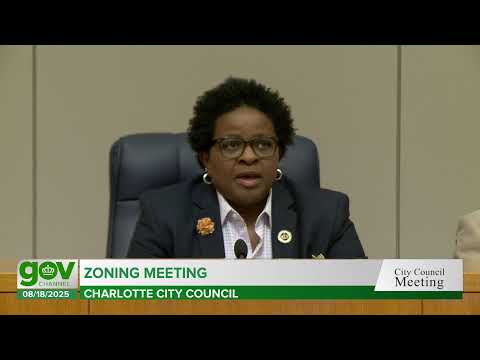
Charlotte’s Zoning Committee heard 27 petitions on Aug. 18, 2025, approving several consent items and taking public testimony on numerous rezonings where neighbors pressed developers on traffic, setbacks and school impacts.
Charlotte’s Zoning Committee heard 27 petitions on Aug. 18, 2025, and moved multiple petitions toward approval while pausing or asking for follow-up on several that drew neighborhood concern. The meeting included a consent vote that carried multiple items and full public hearings on larger rezoning requests that prompted extended public testimony and detailed exchanges with council members and city staff.
The most contested hearings involved a proposed 43-unit townhome project on Valleydale Road (petition 2025027), a 15.8‑acre mixed plan at Plaza Road Extension and Hood Road (2025032), and a 168‑unit multifamily workforce housing project on Tom Hunter Road (2025042). Residents at those hearings focused chiefly on vehicle access and traffic safety, property setbacks and buffers, construction impacts, and how additional housing would affect local school capacity. Petitions that were more conceptual or consistent with the city’s 2040 policy map received shorter discussion.
Why it matters: zoning decisions affect immediate neighbors’ quality of life—noise, driveway relocation, tree removal and traffic—as well as citywide priorities including affordable housing, transit access and parkland. Council and staff repeatedly balanced those community concerns with competing policy goals: increasing homeownership and workforce housing, preserving open space, and connecting developments to transit and greenways.
Key debates
Mission City Church / Freedom Communities (petition 2025027). Staff recommended approval for a proposed rezoning of about 4.77 acres for 43 townhomes, with several conditions including deed restriction of each unit to be “House Charlotte”‑eligible and a seven‑year affordability term. Developer representatives said the change would cut theoretical daily trips from about 970 (the site’s existing commercial zoning potential) to roughly 277 daily trips under the proposed townhome plan—about a 70% reduction in vehicle trips. Mark Talbot of Freedom Communities said the project’s goal is workforce homeownership and neighborhood services; Pastor Kyle Dillard of Mission City Church described the congregation’s long-term ties to the site and said the church wanted to ensure the land would “serve the needs of the community” rather than be sold to the highest bidder. Opponents, notably nearby homeowner Beth Lamons, said the existing driveway/right‑of‑way is narrow, that her home sits roughly 12 feet from the road and that proposed roadway work could reduce her side yard and affect driveway access. Staff and the petitioner told council the Goodman Road extension right‑of‑way will not be widened across private property without voluntary conveyance; CDOT said no capital road projects are currently planned in the immediate vicinity. Councilmembers asked the petitioner to continue neighborhood engagement focused on access and potential pedestrian safety improvements; the public hearing closed for later action.
Plaza Road Extension / Hood Road (petition 2025032). A 15.8‑acre mixed plan calling for a neighborhood center and up to 94 townhome‑style units drew strong opposition from adjacent residents who said the developer had earlier told them nothing would be built behind their backyards. Neighbors cited safety and cut‑through traffic on Hood Road and Plaza Road, wildlife and drainage concerns, and skepticism that promised “affordable” units would be attainable for local households. Petitioner representatives said roughly 25% of the site would remain undeveloped to protect wetlands and amenity space, and that they had offered trail connectivity to adjacent subdivisions; they also noted an existing plan from the 1990s that allowed a shopping center and that the developer had sought to provide commercial services for the broader area. Staff said the petition was inconsistent with the neighborhood‑1 policy map designation but that revisions (building‑form transitions and larger landscape buffers) could make the plan more compatible.
Tom Hunter Road workforce housing (petition 2025042). Petitioner Davis Elsey proposed 168 workforce units restricted at an average of 60% area‑median income, served by adjacent transit and Tom Hunter Park. Hidden Valley residents said the Tom Hunter corridor already suffers high‑speed traffic and safety problems and asked for a signalized or high‑visibility pedestrian crossing at the park, a cumulative traffic study covering nearby developments, and two site access points instead of one. The petitioner said staff did not require a traffic‑impact analysis and that they had reached out to neighboring land owners to explore additional access; staff acknowledged the residents’ safety concerns and said CDOT was open to follow‑up analysis and to discussing partnership funding for pedestrian improvements.
Other notable hearings and staff comments
- Petition 2025056 (Providence Road West) proposed 110 multifamily‑attached units with a 25‑foot Class B landscape buffer; staff recommended approval conditional on design refinements. Council members flagged school capacity and asked planning staff and CMS for clearer cumulative school‑impact reporting. - Petition 2025049 (High Street District, ~32 acres) and petition 2025041 (NVR Inc., ~107 acres in University City) involved larger townhome communities with park dedications and greenway connections; staff recommended approval subject to outstanding site‑design items. - County park proposal (petition 2025060) for W.W. Harris Boulevard: staff recommended approval; County representatives said the plan would preserve open space and deliver an inclusive playground, with streetscape work deferred pending county funding.
Decisions and next steps
Several decision items on the consent and non‑consent portions of the agenda were approved by council during the meeting’s decision portion. Multiple public hearings closed, and several petitions will return to staff and council with follow‑up reports addressing access, buffer, stormwater and pedestrian safety items. Council repeatedly urged petitioners to keep meeting with neighbors and with district council members.
Votes at a glance (items on this meeting)
- Consent: Petition 2025037 (agenda item 3) — approved (consent, unanimous). - Consent: Petition 2025038 (agenda item 4) — approved (consent, unanimous). - Decision: Agenda item 5 (petition number not specified on record) — motion approved (unanimous). - Decision: Agenda item 6 — approved (unanimous). - Decision: Agenda item 7 — approved; Councilmember La Juana Mayfield recorded in opposition. - Decision: Agenda item 8 — approved; Mayfield recorded in opposition. - Decision: Agenda item 9 — approved; Mayfield recorded in opposition. - Decision: Agenda item 10 — approved; Mayfield recorded in opposition. - Decision: Agenda item 11 — approved (unanimous). - Hearings opened and closed (no final vote recorded in transcript): petitions 2025027, 2025032, 2025042, 2025034, 2025040, 2025054, 2025055, 2025056 and others — outcomes not specified in the transcript; petitioners and staff were asked to return with revised plans or additional technical responses.
What council asked staff and petitioners to do
- Continue neighborhood engagement, clarifying access plans and driveway impacts where homes abut proposed right‑of‑way changes. - Provide more thorough CDOT input on pedestrian crossings and cumulative traffic impacts where residents raised safety concerns (Tom Hunter, Valleydale/Goodman). - Where staff deemed a plan inconsistent with the 2040 policy map, return with building‑form and buffer revisions to better transition to adjacent single‑family areas (example: Plaza/Hood petition). - Provide more transparent cumulative school‑impact data for council review (multiple council members asked staff to compile recent approvals and by‑right entitlements within 1 mile of proposed petitions so CMS and council can reconcile capacity calculations).
Bottom line: council signaled broad support for projects that advance affordable or workforce housing when they fit context and when access, safety and buffering concerns are resolved. In several contested cases, council closed public hearing and instructed staff and petitioners to work with neighbors and CDOT on clearer access and pedestrian‑safety commitments before a final decision.
Notes and sources: quotes and on‑record descriptions in this summary come from public testimony and staff presentations recorded in the Aug. 18, 2025 transcript of the Charlotte City Council zoning hearing (speakers cited below). Details such as trip generation (970 vs. 277 daily trips) and specific commitments (e.g., seven‑year deed restrictions, minimum landscape yard widths, number of affordable units) were read into the record by staff and petitioners during hearings and are noted above where relevant.
Looking ahead: council will consider revised petitions and follow‑up staff reports. Several district council members asked for site visits with petitioners and residents before returning to a final decision.