Get Full Government Meeting Transcripts, Videos, & Alerts Forever!
Get email alerts on the Land Use And Utilities topic
No spam. Unsubscribe anytime.
Rising Sun reintroduces annexation for West Nottingham Academy, advances campus and zoo zoning and new utility rules
Summary
Rising Sun reintroduced an annexation resolution for West Nottingham Academy and approved introduction of new zoning and utility measures intended to support the academy and a nearby zoo while protecting town water and sewer capacity.
Rising Sun, Md. — The mayor and board of commissioners on Sept. 30 reintroduced an annexation resolution for West Nottingham Academy and advanced several zoning and utilities measures intended to support the school and regional attractions while protecting the town’s water and sewer capacity.
Town Administrator Calvin told the board the reintroduction corrects an “enclave” found in the July annexation map and restarts the statutory review clock; the annexation process will include a 45-day county review and would not take effect until 90 days after completion of required steps. “We are going into this annexation knowing that West Nottingham Academy is a nonprofit entity,” Calvin said, adding the school needs a town water connection to proceed with planned campus uses.
Why it matters: the package links land-use changes and utility rules to pending growth. The measures aim to let the town provide water and sewer to institutional users (the academy and a nearby zoo), create zoning that limits future conversion to market-rate housing, and require developers to share the cost or reserve capacity so ratepayers do not shoulder the full expense of system upgrades.
What the board approved or advanced
- Reintroduction of resolution 2025-16a to restart the annexation process for West Nottingham Academy. Calvin said the reintroduction corrects mapping that created an impermissible enclave; the board voted to accept the resolution and start the review process.
- Introduction of ordinance 2025-03 to create an Educational and Cultural Campus (ECC) zoning district for the academy’s campus. The ECC district, as described by Calvin, would permit core campus uses (research/academic facilities, student dormitories and faculty housing tied to campus use, dining halls, performance spaces and educational conference facilities) and prohibit unaffiliated general commercial retail, standalone industrial uses and market-rate residential subdivisions not linked to the campus. The planning commission reviewed the language on Aug. 18, Sept. 8 and Sept. 22 and recommended proceeding to public hearing.
- Introduction of ordinance 2025-04 to align the town’s childcare/daycare zoning rules with state (COMAR) standards. Key changes include matching the state’s requirement for outdoor play area calculations (based on maximum number of children outdoors at one time) and adding a minimum of 35 square feet of usable indoor activity space per child (exclusive of kitchens, bathrooms, halls, staff rooms and storage).
- Introduction of ordinance 2025-05 to create a Zoo or Zoological Park zoning district for the municipal partner attraction (referred to in meeting materials as a local park/zoo). That draft district would permit zoological parks, animal habitats, visitor centers, cafeterias and gift shops as uses by right, and make certain large-amphitheater uses (200 or more seats) subject to special exceptions and additional review. Calvin said the zoo attracts more than 100,000 visitors annually and that annexation would open state grant opportunities and allow utility service to address nitrate concerns.
- Introduction of ordinance 2025-06 (chapter 8 changes) to require greater interconnection and redundancy in the town’s water distribution and to formalize design standards so new subdivisions provide robust, two-directional feed when feasible.
- Introduction of ordinance 2025-07 and authorization to use a sewer and water capacity-reservation agreement. The ordinance would authorize formal capacity-reservation agreements and establish a deposit/reservation framework. Calvin told the board a reservation requires an upfront deposit equal to 2% of the total impact-fee obligation for the reserved number of equivalent dwelling units (EDUs), a five-year reservation window and a requirement that 25% of the reserved project be completed within five years or the reservation and deposit would lapse.
Calvin said staff and the town attorney are finalizing a specific sewer/water capacity-reservation contract with a developer; the board authorized the mayor or the town administrator to execute the agreement once the town attorney approves the language and the developer posts the required deposit.
Impact fees and system upgrades
Calvin and staff outlined infrastructure needs that drive the town’s proposed impact-fee schedule. Engineering work identifies costs for added interconnections, new storage and wastewater-plant improvements. Highlights provided at the meeting:
- The town currently holds a 500,000-gallon water tank and a million-gallon allocation; additional storage is needed if the town sells more water. Calvin said the plan calls for additional tankage (the presentation cited two 200,000-gallon tanks in connection with looping and redundancy work).
- Wastewater treatment needs include decommissioning an existing lagoon, installing solids-handling equipment such as a belt filter press, and replacing two undersized interceptor sewer lines and addressing inflow-and-infiltration (I&I). Calvin said the work to the wastewater plant and interceptors is necessary before additional development can be served.
- The town’s engineering and planning analyses (KCI engineering referenced) produced a proposed impact-fee figure of roughly $21,000 per connection. Calvin noted that of that amount approximately $14,000 represents recovery of prior system investments that town taxpayers already paid for, with the remainder funding upgrades required for new development. He said the town expects roughly $28 million in total impact-fee revenue at full build-out of the queued projects.
Process and next steps
Most of the ordinances were accepted for introduction (to start the 14-day notice and scheduling of required public hearings where the law requires). The annexation resolution will be transmitted for a 45-day county review and state review under the statutory annexation process and, if completed, would take effect on the timeline set by statute. The town will publish public-hearing notices for the ECC and related district texts and return to the board for final adoption votes after the public comment period.
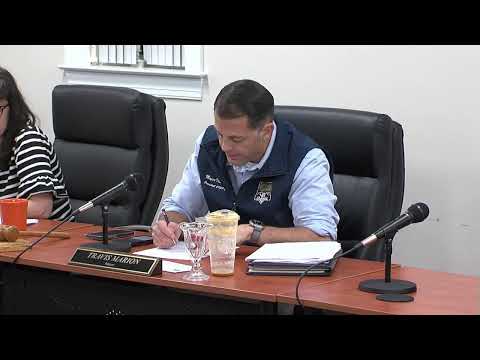
At the meeting Mayor Marion framed the package as part of a long-term sustainability plan: “We are at a turning point,” Marion said, tying the measures to past investments in water and sewer and to the town’s goal of stabilizing rates and enabling managed growth.
Ending note
Board members moved and seconded each item; formal roll-call tallies were not recorded on the public audio for each vote, but the board adopted the motions to reintroduce the annexation resolution and to accept the ordinances for introduction and to authorize execution of the capacity-reservation agreement once attorney review and deposit conditions are met. Public hearings and additional ordinance-adoption votes will follow the required notice periods.