Get Full Government Meeting Transcripts, Videos, & Alerts Forever!
Get email alerts on the Doe Budget Setf topic
No spam. Unsubscribe anytime.
D.C. council hearing: advocates warn mayor—s FY26 cuts would 'devastate' Department of Energy and Environment
Summary
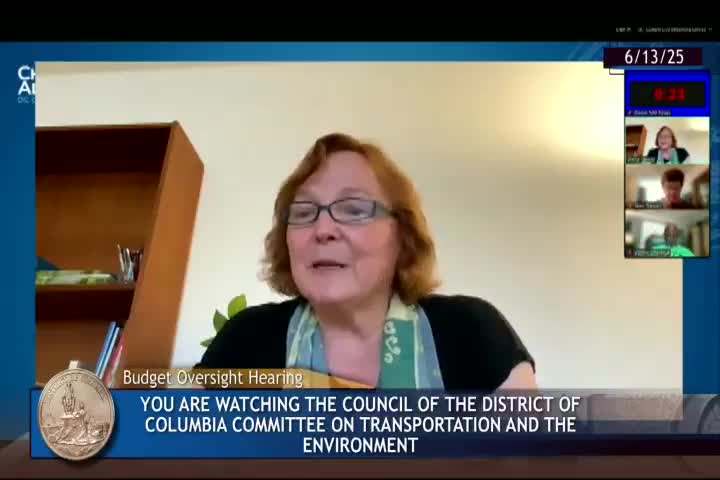
Chair Charles Allen convened a marathon budget hearing on June 13 after hundreds of witnesses registered to speak about Mayor Bowser—s proposed FY26 cuts to environmental programs. Former council members, community groups and developers told the Committee on Transportation and the Environment that sweeping special-purpose funds to pay city utility bills would cripple the Department of Energy and Environment and jeopardize clean-energy, stormwater and education programs.
Chair Charles Allen convened a marathon budget oversight hearing on June 13, where more than 130 public witnesses testified on the mayor—s proposed FY26 operating plan for the Department of Energy and Environment (DOEE), the DC Sustainable Energy Utility (DCSEU) and the DC Green Bank. Witnesses repeatedly urged the council to restore local funding the mayor proposes to sweep into the general fund.
At the hearing, former Council Chair Mary Che said bluntly, "This budget will devastate DOE," and urged immediate action to protect long-running programs. Former Councilmember Tommy Wells said the proposal "severs the trust of our residents" because fees collected to support climate and water work would be diverted to general expenses. Advocates and agency partners warned the cuts would end or sharply reduce the Healthy Homes and RiverSmart programs, environmental education grants, green-infrastructure maintenance and volunteer water quality monitoring.
Why it matters: DOEE administers the city—s environmental permitting and many grant programs, the DCSEU runs energy-efficiency and electrification programs that target low- and moderate-income households, and the Green Bank offers gap financing for projects that private capital would otherwise avoid. Panelists said the mayor—s plan to use Sustainable Energy Trust Fund (SETF) fees to pay city utility bills is effectively a ratepayer tax repurposed for general government spending and would undermine future matching grants and long-term projects.
Former DOEE director Tommy Wells, appearing as a private witness, told the committee the proposed SETF sweep and other cuts break a compact with residents who agreed to small charges on bills expressly to fund energy and stormwater work. "The mayor—s proposed budget," he said, "breaks the mayor—s and city council—s promise to use these revenues for investments on a cleaner, healthier city." Chris Weiss of the DC Environmental Network added, "Put back the sustainable energy trust funds—stop the mayor from using DOEE like an ATM."
What was explained at the hearing
- Cuts and transfers: DOEE—s FY26 local operating funds were described at the hearing as down (the mayor—s published packet shows a 24% reduction in the agency—s operating budget compared with FY25). Witnesses said the impact is larger when grants and special-purpose revenues that support multi-year programs are treated as —lapsing— and swept into the general fund. Speakers cited the mayor—s proposed transfers from the SETF and the Anacostia River Cleanup and Protection Fund (the —bag fee— fund) as central examples.
- Programs at risk: Advocates said the Healthy Homes Act, Solar for All, DCSEU retrofit programs, green infrastructure maintenance, trash-trap maintenance on the Anacostia, river education and boat tours, the volunteer water-quality monitoring program and lead-pipe replacement assistance would be jeopardized or delayed.
- Legal/permit risk: Multiple witnesses warned the city could fall out of compliance with federal stormwater (MS4) permit obligations and face fines or lawsuits if local funding for stormwater and compliance monitoring is cut.
- Equity, health and jobs: Witnesses from community-based groups, faith organizations and workforce programs said the cuts would hit residents in Wards 5, 7 and 8 hardest and would imperil green jobs and youth workforce programs. "Seniors, low-income families and children would be hurt," said Katie Fraser Plant, who described using DOE and DCSEU funds at her family home.
Council work ahead: Chair Allen said the committee will try to claw back as much of the swept funding as possible during the mark-up and full-council process, including exploring alternative revenues and negotiating with other committees. He also urged witnesses to file written testimony through the council—s hearing system by the close date (06/20/2025)."The budget in front of us is devastating," he said at the session—s outset; witnesses asked the council to restore special-purpose funds and reject Budget Support Act language that converts non-lapsing funds into lapsing funds.
Ending: The hearing offered a single, repeated message: restoring the money that pays for long-term, multi-year environmental and equity programs is both a budget question and a question of trust. "When you cut these funds," former Councilmember Mary Che told the committee, "you undermine the covenant that was made with residents who paid these dedicated fees." The committee will take written testimony through June 20 and continue mark-up work in coming weeks.