Lifetime Citizen Portal Access — AI Briefings, Alerts & Unlimited Follows
Council hearing on mayor’s proposed consolidation draws warnings over pooled grants and cultural competence
Loading...
Summary
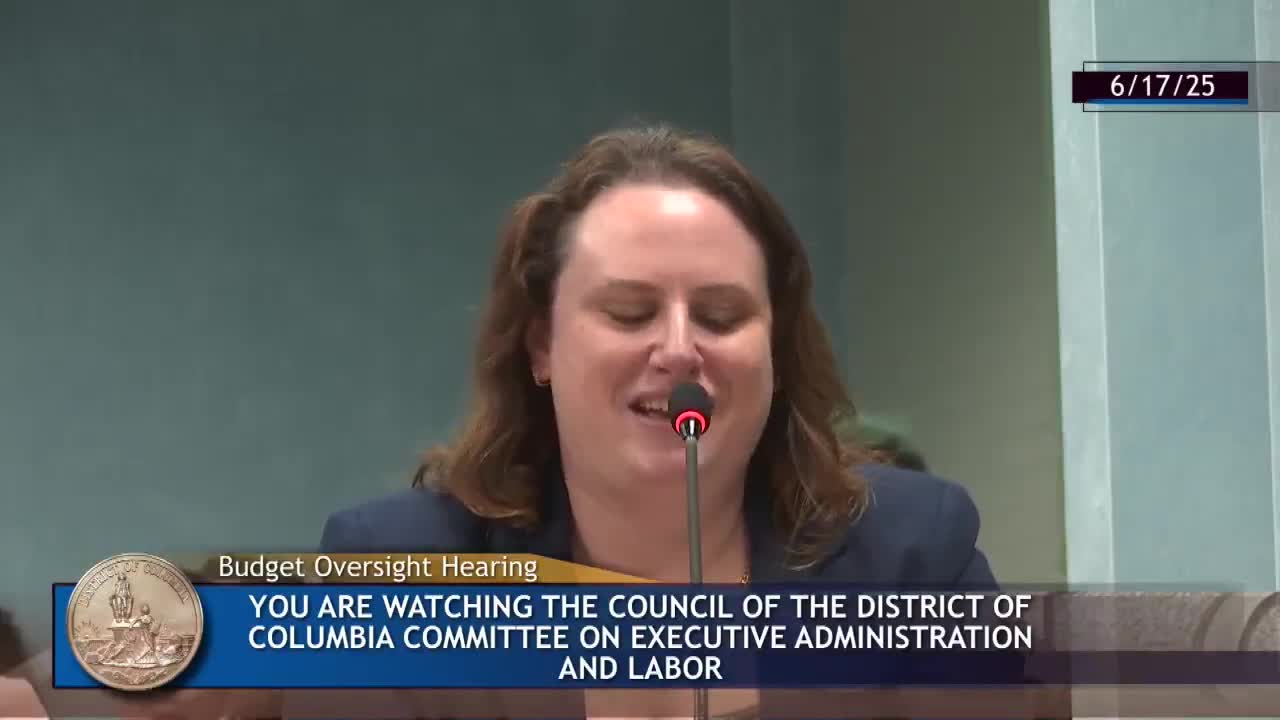
At a June 17 hearing of the Committee on Executive Administration and Labor, council members and community witnesses pressed the mayor’s office for details about a proposed FY26 restructuring that would consolidate multiple constituency and cultural affairs offices under the Executive Office of the Mayor.
At a June 17 hearing of the Committee on Executive Administration and Labor, council members and community witnesses pressed the mayor’s office for details about a proposed FY26 restructuring that would consolidate multiple constituency and cultural affairs offices under the Executive Office of the Mayor.
The hearing focused on how the reorganization would affect grant-making, staffing and culturally specific services provided by offices such as the Mayor’s Office on Latino Affairs (MOLA), the Mayor’s Office of Community Relations and Services (MOCRs), and the mayor’s offices for Asian and Pacific Islander affairs, African American affairs, LGBTQ affairs and others. Nonprofit leaders and residents warned that pooling grant funds and centralizing administration could weaken culturally competent service delivery and slow grant awards.
“This connection between D.C. residents belonging to vulnerable groups and the executive office of the mayor is vital,” said Alicia Yoss, policy counsel for the American Civil Liberties Union of the District of Columbia (ACLU-DC), testifying about the mayor’s proposed change to the mayor’s office of community affairs. She warned that “a combined and reduced staff is unlikely to have the cultural competencies for all the 13 constituencies that are currently served.”
Abel Núñez, executive director of the Central American Resource Center (CARESN), told the committee, “MOLA is not just an office, it is a touchstone for the communities it serves.” Several witnesses described concrete services that depend on constituency offices’ grants and relationships — legal representation and interpreter services, youth after-school programming, and violence-prevention coordination — and said those services could be disrupted if grant administration is changed without clear rules and timelines.
Ayuda, a legal services nonprofit, asked the Council to restore or expand grant funding for immigrant legal services. Sandra Benavente, Ayuda’s advocacy manager, said Ayuda’s community legal interpreter bank “filled 315 requests for interpretation for grantees” in FY24 and requested the council consider increasing the pooled funding that supports legal and language-access services; the group proposed increasing that line from $3,500,000 in FY25 to $7,000,000 in FY26.
Gala Hispanic Theatre’s Rebecca Medrano and a student from Gala’s Paso Nuevo program described youth programming that they said depends on MOLA support. Medrano said Gala serves thousands of students annually with bilingual school matinees and after-school programs that she said would be hard to sustain without continued MOLA funding. The Latino Student Fund’s Maria Fernanda Borja said the organization served roughly 11,000 youth since its founding and about 1,000 students in the current school year, and that MOLA funding helps maintain those programs.
Administration officials defended the restructuring as an administrative realignment rather than a dismantling of offices. Lindsay Parker, chief of staff to Mayor Muriel Bowser, described three new “teams” inside the Executive Office of the Mayor: a Community Relations team (including MOCRs, Clean City and religious affairs), a Cultural Affairs team (including MOLA and other constituency offices) and a Community Partnerships team to centralize volunteer, philanthropic and some grant functions. Parker said the EOM’s FY26 budget proposal includes $31,000,000 for the office and about 170 full-time equivalents (FTEs), and that the consolidation reflects a net reduction of about 4.5 FTEs tied to eliminated vacancies.
Parker said the consolidation of grant lines into a Community Partnerships budget line — a $5,000,000 line in EOM’s proposal — is an accounting consolidation rather than new money. “This amount is not new funding, but rather a consolidation of the existing grant dollars from the various agencies,” Parker said, adding that “all offices will remain intact.” She also said the Mayor’s Office on the Deaf, Deafblind and Hard of Hearing would move to the Department on Disability Services to centralize disability services.
Panel director Jackie Reyes, named to lead the Cultural Affairs and Community Partnerships teams, said the offices will continue to provide services in all eight wards and flagged outreach numbers she and the offices track. “We have reached out more than 300,000 residents,” Reyes said, and she urged community members to report problems if they experience service disruptions.
Witnesses and council members asked for concrete assurances about grant timing and structure. Several nonprofit witnesses said they have not received clear notices about how to apply in FY26 and worried that pooled grant administration could delay RFA (request for application) timelines. Parker told the committee that timing changes seen this year were driven in part by federal-level budget and continuing-resolution complications and by the need for the Council to review the FY26 proposal; she said EOM would communicate timelines to prospective grantees.
Councilmember Matthew Fruman (chair of the Committee on Human Services), who shares oversight of many of the affected offices, said he will press administration witnesses for statutory and operational clarifications, noting that some offices were created by statute. He asked how directors who are closest to communities will remain part of grant decisions; Parker and Reyes said directors will continue to participate in grant design and community outreach even as grant administration is consolidated for efficiency.
The committee record remains open for written testimony until July 1 at 5:30 p.m., the chair announced. Committee members said they will continue to seek more detail on how the reorganization will preserve culturally specific services, timelines for grant solicitations, and whether philanthropic matching can be used to expand the effective grant pool.
Next steps noted at the hearing included additional follow-up materials from the mayor’s office, an organizational chart showing the new configuration, and continued committee oversight during the FY26 budget review process.