Lifetime Citizen Portal Access — AI Briefings, Alerts & Unlimited Follows
Senate Taxes Committee reviews SF 2374 omnibus tax bill; film credit cuts and local aid reductions draw pushback
Loading...
Summary
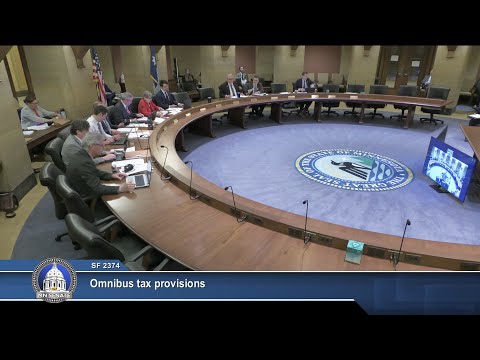
The Minnesota Senate Taxes Committee met May 7 to review Senate File 2374, the omnibus taxes "delete everything" amendment, hearing counsel present the measure article by article and taking public testimony on high-profile provisions including a proposed cut to the film production tax credit, proposed reductions in local government and county program aid, and a proposed social media platform tax.
ST. PAUL, Minn. — The Minnesota Senate Taxes Committee on Wednesday reviewed Senate File 2374, the omnibus taxes “delete everything” amendment, hearing a section-by-section presentation from nonpartisan counsel and public testimony on multiple provisions ranging from a proposed increase in the net investment income tax to a new tax on social media platforms.
Committee counsel told members the bill as drafted would increase general fund revenues by about $625.6 million over the next four years while reducing property tax aids and credits by about $109.4 million, producing a combined general- fund savings of roughly $735 million. Major changes highlighted included raising the net investment income tax rate from 1% to 1.5% (an estimated $144.5 million), a $1 million-per-year cap on film production tax credits (noted as a $8.6 million reduction across four years), repeal of local government cannabis aid (about $64.6 million to the general fund), and a proposed excise tax on social media platforms estimated to raise $334.3 million.
“Madam chair and members, you have produced a good bill that will go a long ways in helping to solve the ongoing structural budget deficit and also helping Minnesotans at the same time,” Paul Marquardt, commissioner of the Minnesota Department of Revenue, told the committee when testifying on behalf of the governor.
The hearing produced focused public comment on several hot-button provisions. Representatives of the Minnesota film industry and labor unions urged lawmakers not to reduce the state film production credit. Mandy June Turpin, a Minnesota-based producer, said, “A $1,000,000 tax credit will not sustain this industry. Minnesota will lose.” Ricky McManus, chief production officer at the Upper Midwest Film Office, described how the tax credit supported productions outside the Twin Cities and helped build a crew pool across Greater Minnesota.
Opposition also came from local governments and county officials over proposed cuts to local government aid (LGA) and county program aid (CPA). Patricia Naumann, executive director of Metro Cities, said the association “would respectfully oppose the reduction in local government aid for cities contained in this bill,” adding that LGA is “a key component” of the state-local fiscal partnership. Mike Slavic, a Dakota County commissioner and president of the Association of Minnesota Counties, warned that cuts to CPA would drive property tax increases and strain county services that deliver social safety-net programs.
Industry groups also testified against other provisions. Tyler Geers of TechNet urged the committee to reject the proposed social media platform tax, warning it likely would face legal challenges under the federal Internet Tax Freedom Act and could raise costs for Minnesota advertisers. Business groups including the Minnesota Chamber of Commerce and Minnesota Business Partnership urged rejection of the proposed net investment income tax increase and other provisions they said would harm competitiveness.
Committee counsel presented numerous technical and programmatic details: an extension of the data center sales tax exemption sunset to the earlier of 20 years after first qualifying purchase or June 30, 2062; a one-time June remittance of 10.896% of estimated sales-tax liability in 2027 to shift revenue between fiscal years; exclusions and subtractions for certain discharged debt and consumer enforcement compensation for renter and property tax refund calculations; and a proposed sustainable aviation fuel credit with supplemental per-gallon incentives tied to carbon-intensity reductions.
Senate nonpartisan counsel and fiscal staff said the bill contains many targeted local provisions — tax exemptions and special TIF authorizations for specific cities, property-tax classification changes for agricultural and resort properties, and several small appropriations — and that several articles have “no fiscal effect” within the four-year budget window but could affect later years (for example, property-tax effects when a generation facility comes online).
Committee leadership signaled the process will continue: members were told amendments will be considered, and documents in the committee packet should be reviewed ahead of further debate. No roll-call votes on omnibus provisions were recorded during the hearing; the committee did approve the minutes from its May 6 meeting at the start of the session.
The committee will take additional amendments and return to the bill; members said they expect conference and floor action to follow as the session proceeds.