Lifetime Citizen Portal Access — AI Briefings, Alerts & Unlimited Follows
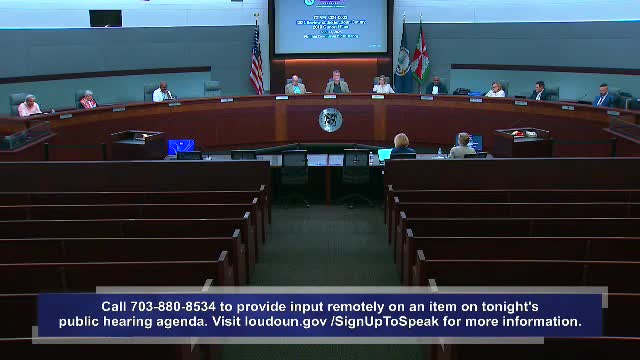
Planning commission sends 2019 general plan review to work session; debates infill, ADUs and office-to-residential
Loading...
Summary
The commission voted 8-0-1 to move the CPAM 2024 review of the 2019 Loudoun County General Plan to a June 12, 2025 work session, after a wide-ranging discussion of proposed edits on building heights, infill criteria, attainable housing targets, land-in-lieu for ADUs and potential office-to-residential conversions.
Rebecca King, project manager in the Department of Planning and Zoning, briefed the commission on CPAM 2024 (the 2024 review of the 2019 Loudoun County General Plan). King said the initiative is primarily housekeeping to correct errors and clarify language; it also proposes several policy clarifications and additions, including building-height ranges, refined infill criteria, updated affordable-housing expectations and potential Zoning Ordinance Amendments (ZOAMs) to address infill flexibility, land-in-lieu for ADUs and repurposing underutilized office/commercial space.
King told commissioners staff propose increasing the affordable-housing expectation for multifamily from the previous 10–15% range to 13.75%, with an avenue for an applicant to provide an additional 2% of units at 30% of area median income (AMI) or 5% at 70–100% AMI. Staff also proposed numeric changes to the working definitions of infill: reducing the urban policy-area infill threshold from 5 acres to 3.5 acres and the suburban policy-area threshold from 20 acres to 10 acres. The CPAM package would add building-height ranges in feet for several place types to give clearer expectations for "1 to 3 stories" language in the plan.
King said staff recommend adding a consultant-led feasibility study and a ZOAM to explore office-to-residential conversion potential in Loudoun and to evaluate allowing multifamily attached dwellings in certain commercial zoning districts. She described outreach to stakeholder groups — the Affordable Dwelling Unit Advisory Board, the Housing Advisory Board and developer associations — noting 16 organizations were invited to a roundtable and 12 participated.
Commissioners discussed multiple topics at length. Several asked for clearer guidance and guardrails on the suburban compact neighborhood (SCN) place type to ensure compatibility with adjacent low-density neighborhoods; Commissioner Frank asked whether measurable limits could be applied so density shifts are not perceived as “too subjective.” Commissioner Myers urged staff to consider how "preexisting houses" on otherwise developable lots should be treated in infill definitions and suggested commissioners explore options for donation or reuse of driving-range equipment in redevelopment cases. Commissioner Burns asked for clarification of the ADU income bands and implementation practices; staff confirmed ADU rentals typically serve households at 30–50% of AMI and ADU ownership targets households at 50–70% of AMI and offered to provide implementation detail from Housing staff in future briefings.
King emphasized the CPAM does not propose remapping place-type boundaries or making rural-policy-area changes; most edits are text clarifications, updated maps (six maps updated to reflect new data such as impaired streams and facilities), and policy language to incorporate board-adopted strategies including the 2023 energy strategy and the unmet housing needs strategic plan. Staff recommended the commission endorse the CPAM and the related ZOAMs and send the matter to a planning commission work session for more detailed line-by-line review.
Commissioner Myers moved to send the CPAM review to the June 12, 2025 planning commission work session; Commissioner Frank seconded. The motion carried 8-0-1 with Commissioner Combs absent. Commissioners indicated they expect further line-by-line discussion at the work session and asked staff to return with clearer red-lined language, sample maps, and implementation details on ADUs, land-in-lieu metrics and the consultant feasibility scope for office-to-residential conversion.