Get Full Government Meeting Transcripts, Videos, & Alerts Forever!
Get email alerts on the Housing Policy topic
No spam. Unsubscribe anytime.
Developers and housing advocates press D.C. Council to modernize TOPA, fix courts amid foreclosure crisis
Summary
At a March 12 roundtable, developers urged the Committee on Business and Economic Development to modernize the Tenant Opportunity to Purchase Act, streamline entitlement processes and consider temporary tax incentives, while housing advocates warned of a foreclosure crisis tied to pandemic-era protections and court delays.
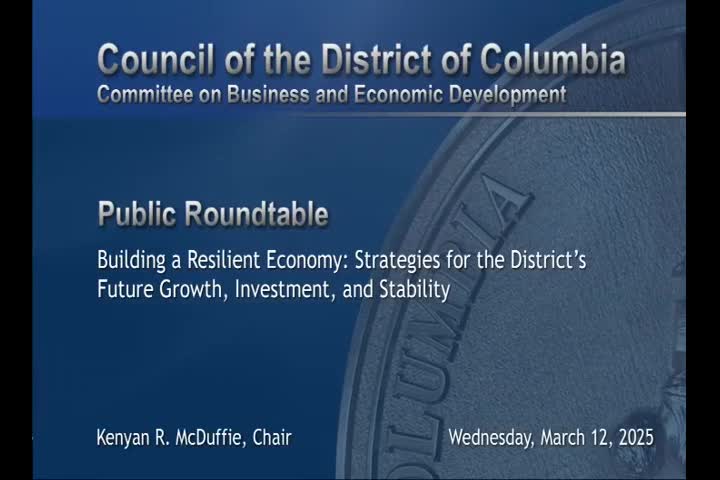
At an oversight roundtable of the Committee on Business and Economic Development on March 12, 2025, developers, housing providers and nonprofit advocates urged the D.C. Council to modernize the Tenant Opportunity to Purchase Act, speed entitlement decisions and reform landlord-tenant court procedures to restore investor confidence and protect committed affordable housing.
The testimony came as the District confronts a shifting federal landscape and a downward revenue outlook: Council Chair Kenya McDuffie noted the Chief Financial Officer’s February 2025 forecast projecting an average annual revenue decline of $342,000,000 from fiscal 2026 through 2028 and observed that the city’s reserves equal about 52 days of operating capital. Witnesses said those pressures magnify risks to both market-rate and subsidized housing.
Why this matters: panelists said court delays, pandemic-era tenant protections and layered local regulations have increased costs for owners and lenders, driving away institutional capital and putting mission-driven affordable properties at risk of foreclosure. Housing Association of Nonprofit Developers Executive Director Courtney Battle told the committee “the foreclosure crisis is massive and affects the entire affordable housing industry in the District,” and provided DHCD figures that about 22,000 government-subsidized units — housing roughly 48,000 residents — are at risk.
Developers pushing TOPA reform and regulatory relief
Local developers and capital-market specialists urged changes they said would restore liquidity and accelerate production. Jair Lynch, president and CEO of Jair Lynch Real Estate Partners and a member of the developer roundtable, told the committee that the District needs more supply — “in 2025, we should say it’s supply stupid” — and backed provisions in the mayor’s Rental Act that would modernize TOPA and create predictability for refinancings and sales.
Christine Espinshade, Vice Chairman of Multifamily Capital Markets at Newmark, presented market data showing institutional investors largely bypass multifamily in D.C. She said institutional buyers accounted for only 13% of multifamily purchases in D.C. since 2018 compared with roughly 30% in Northern Virginia and argued that institutional avoidance lowers prices, reduces transfer-tax revenue, and shrinks the pool of low-cost capital that sustains building maintenance.
Roadside Development managing partner Richard S. Lake and Akash Thakkar of EYA added that lengthy discretionary entitlement processes such as PUD appeals, and design and community review delays, discourage large-scale investment. Lake estimated that protracted processes can leave developers unable to capture density and affordable housing that otherwise would have been delivered, and urged the council to limit new regulatory burdens while TOPA reform and other fixes take effect.
Housing providers cite ERAP abuse, court backlogs and foreclosure examples
Nonprofit and mission-driven providers described a separate but related crisis: high rates of unpaid rent, lengthy eviction backlogs and the resulting financial distress for affordable properties. Courtney Battle said lenders perceive the District’s court system as unable to enforce leases efficiently, discouraging financing for preservation and development.
HAND and other witnesses cited several data points: a coalition of housing providers representing nearly 20,000 units reported nearly $50,000,000 in unpaid rent, DCHFA’s watch list of troubled properties rose from five in 2019 to 47 today, and delinquency rates have climbed from roughly 5% to 30%. Buah Benitez, founder and CEO of Dumas Collective, said his company’s delinquency total rose from about $700,000 last year to roughly $3,000,000 so far in 2025. Committee witnesses also pointed to a 435-unit property, Meadow Green Courts, that the panel was told entered foreclosure during the period under discussion.
Panelists and HAND called for court-process reforms: shortening timelines for hearings, limiting the ability of pending ERAP (Emergency Rental Assistance Program) applications to indefinitely stay eviction cases, closing procedural loopholes that create months-long delays (including “Lehi” habitability hearings), and requiring demonstration of need for ERAP rather than allowing broad pending status to stall cases.
Policy proposals and tradeoffs discussed
Witnesses proposed a mix of immediate and longer-term steps: TOPA modernization targeted at newer and larger buildings (exempting a small subset of well-maintained institutional assets), a more limited and time-bound tax-abatement program to jumpstart new multifamily production (one witness suggested a temporary 50% abatement for new starts), streamlined PUD and entitlement procedures, and administrative fixes to reduce construction costs (for example, easing limited work-hour rules and reducing hauling and permitting frictions).
Several witnesses recommended adopting a right-of-first-refusal model similar to Prince George’s County — where prequalified mission-based providers can match an offer — rather than an open-market TOPA process that developers say invites delay and speculative bidding.
Costs and regulatory examples
Panelists gave specific cost examples they said compound the problem: testimony referenced roughly $1 million in added costs to replace windows to meet the District’s migratory-bird rules for a single building, a separate million-dollar bill to relocate and preserve mature on-site trees, and an estimate that Davis-Bacon requirements add roughly 15% to construction cost on some public projects. Witnesses also noted the Clean Energy Building Code amendments and building energy performance standards (BEPS) as additional drivers of near-term construction cost.
What witnesses did not resolve: balancing protections and production
Multiple witnesses emphasized they were not urging deregulation that eliminates tenant protections in general, but rather targeted modernization so rules reach their intended beneficiaries. Richard Lake, Akash Thakkar and others said TOPA in its current form was designed in the 1980s to prevent displacement but has not been updated to work alongside modern federal tax credits, Housing Production Trust Fund projects and inclusionary zoning commitments.
Next steps and record
Council Chair Kenya McDuffie closed the roundtable saying the Rental Act and other measures deserve hearings given the fiscal and housing stakes. The committee invited written testimony to be submitted through the Council’s hearing management system; the record was left open until 5 p.m. on March 21, 2025.
Ending: witnesses and Council members agreed that any reform should protect tenants in older rent‑controlled stock while creating predictable pathways for investment in newer and larger properties — a mix of preservation spending for mission-driven providers and regulatory modernization to bring capital back to D.C.