Get Full Government Meeting Transcripts, Videos, & Alerts Forever!
Get email alerts on the Extended Producer Responsibility topic
No spam. Unsubscribe anytime.
California hearing highlights SB 54 rollout, dispute over producer-led programs and enforcement
Summary
State officials, industry groups, environmental advocates and local governments told a California Senate informational hearing that Extended Producer Responsibility (EPR) can drive reductions in waste and redesign of products, but they disagreed about program design, enforcement and who should oversee implementation of new programs such as SB 54.
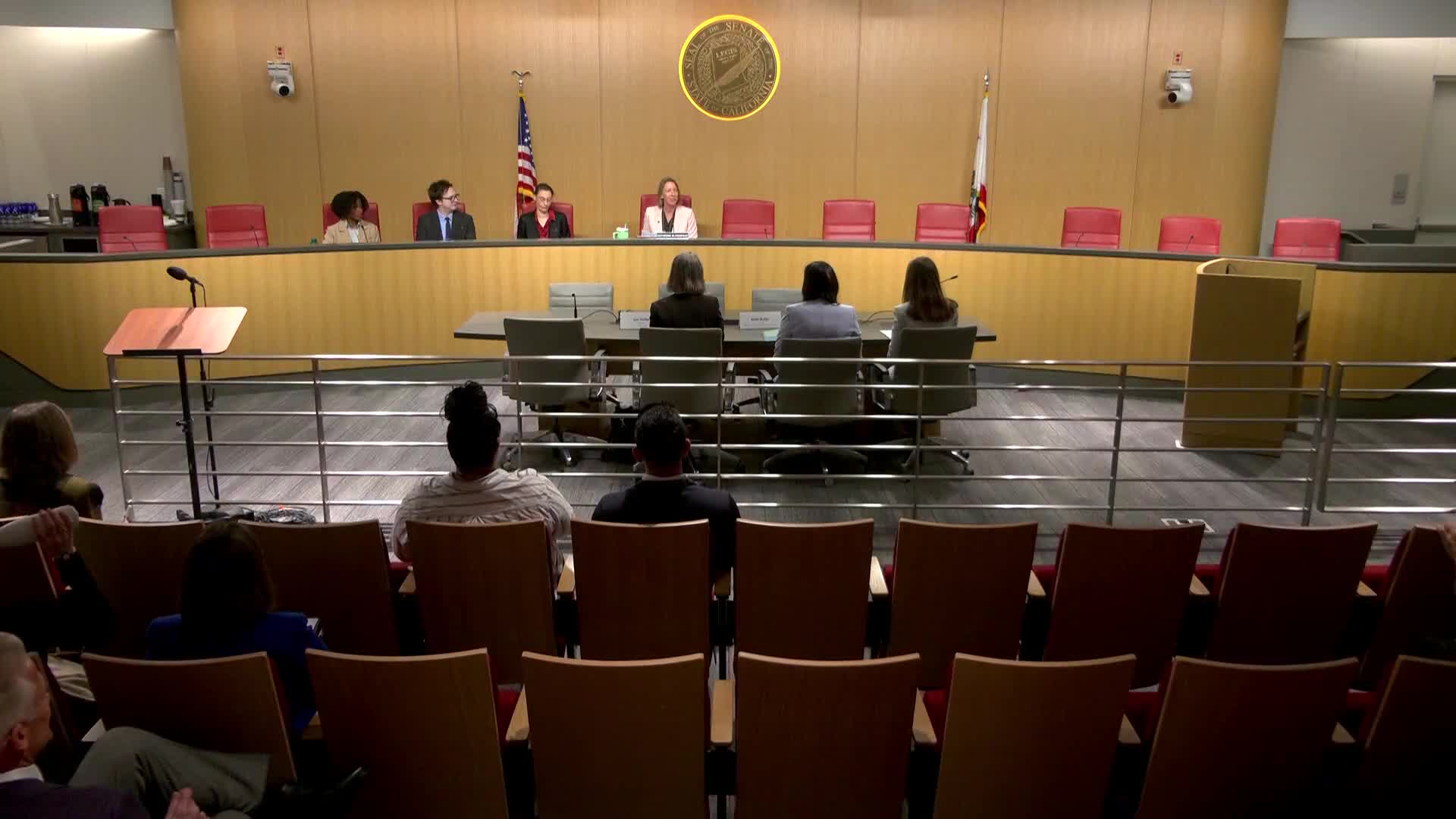
The California Senate Environmental Quality Committee convened an informational hearing on Extended Producer Responsibility (EPR) programs where state officials, industry representatives, environmental groups and local governments discussed the state's recent EPR laws and the challenges of implementation.
Madam Chair opened the hearing by saying the session would address "Extended Producer Responsibility in Action, Policy Progress and Pitfalls" and that she was "a strong believer that EPR can drive real world systems level change and help the state reaches waste diversion and recycling goals." The chair noted that regulations implementing SB 54 are "top of mind" and said the regulations "must be authorized by March 8," a deadline she urged be met so the law can begin operating.
The hearing brought into relief three core fault lines: how prescriptive statute and regulations should be versus relying on producer responsibility organizations (PROs) to implement programs; how enforcement should be structured and resourced; and which products are suitable for EPR.
Zoe Heller, Director of the California Department of Resources, Recycling and Recovery (CalRecycle), described CalRecycle's role in implementing EPR and the agency's checklist of elements for successful programs. "EPR makes industry responsible for funding these programs," Heller said, adding that California's EPR programs have recovered "34,000,000 gallons of paint, 11,000,000 mattresses, 1,000,000,000 pounds of carpet" since inception. She summarized key program components the agency expects: clear roles and responsibilities, enforceable performance standards (including "free and convenient collection sites"), reporting and auditing requirements, civil penalties and data-driven oversight.
Katie Butler, Director of the Department of Toxic Substances Control (DTSC), said hazardous or reactive wastes require a "fit-for-size" EPR approach. "Hazardous waste is a subset of solid waste and is subject to significantly more requirements just due to the inherent risks of hazardous waste," Butler said, adding that some wastes'for example, expired marine flares'present unique disposal barriers. The chair later said she introduced SB 561 this year to create an EPR program for expired marine flares because "there is currently no facility in California that has the permits to dispose of these flares."
Environmental groups, including Ocean Conservancy and Californians Against Waste, argued for strong statutory targets and explicit guardrails. Dr. Anya Brandon of Ocean Conservancy said lawmakers should "be very clear about both what the EPR program must accomplish and how the EPR program should operate," and argued that targets and transparency enable enforceability and public trust. Nick Lapis of Californians Against Waste praised CalRecycle for regulatory oversight but warned of abuses in some producer-run programs, citing instances where fee revenues were used for lobbying or other activities not intended by legislation.
Industry representatives, including Don Kupke of the California Manufacturers and Technology Association and Christine Wolf of Waste Management, emphasized flexibility and predictability for manufacturers and service providers. Kupke said producers are investing in design changes and that "EPR may not be the right fit for all packaging, all products, and all instances." Wolf said service providers and local governments need clear, stable targets to make long-lived infrastructure investments, and she warned that sudden "jolts to the system" (for example, changes in export markets or new waste types such as lithium-ion batteries) can destabilize recycling programs.
Community and environmental justice speakers raised concern about industry-run programs when affected communities have low trust in polluters. Thomas Helm of Valley Improvement Projects said, "When we see programs where the industry is given a large say over how the program is going to be laid out ... we right off the bat are going to be very skeptical." He urged stronger community outreach and inclusion in program design and siting.
CalRecycle's deputy director for compliance, Mark DeBee, described a "compliance-first" enforcement philosophy that emphasizes education, notices of violation, corrective action plans and administrative penalties when needed. He said streamlined settlements can encourage quick return to compliance and that timely, regular reporting improves CalRecycle's ability to detect noncompliance earlier.
Speakers who have worked on existing EPR programs, including Heidi Sanborn of the National Stewardship Action Council and Doug Cobalt of the California Product Stewardship Council, urged stronger transparency in PRO governance, meaningful eco-modulated fees to drive design change, and data collection that measures public awareness and program use, not just brochure counts. Several witnesses flagged the carpet stewardship program's governance and compliance as an example where plan-level commitments and program practices diverged: industry representatives and watchdogs both noted fines levied against the carpet program and disputes about plan implementation.
Public commenters representing local governments, retailers, agricultural and food sectors, solar panel advocates and others emphasized the need for coordination across state and local rules, alignment with other agencies such as Cal/OSHA and public health, and careful attention to costs for small businesses and consumers. Multiple commenters urged that EPR be used to reduce costs over time by incentivizing source reduction and reuse rather than merely shifting costs to ratepayers.
Why it matters: California's recent EPR measures'notably SB 54 (single-use plastics and packaging), a textile EPR law and battery proposals'aim to shift the cost and responsibility for end-of-life management to producers, driving redesign, new collection systems and increased recycling. Stakeholder testimony at this hearing shows broad agreement on the goal but sharp disagreement on who should run programs, which statutory guardrails are required, how enforcement should be applied and how to protect vulnerable communities and public health.
Looking ahead: The hearing made clear that implementation details'statutory specificity on targets and guardrails, agency authority to enforce plan commitments, transparent PRO governance, eco-modulated fee structures and proactive public education'will determine whether new EPR programs deliver on their promises or perpetuate gaps in collection, equity and enforcement.
Ending note: Several speakers urged urgency. The chair and multiple environmental groups pressed CalRecycle and the administration to finalize and use regulatory authority to ensure SB 54 and other EPR statutes translate into measurable reductions in waste and stronger markets for recyclables.