Get Full Government Meeting Transcripts, Videos, & Alerts Forever!
Get email alerts on the Transportation Smart Scale topic
No spam. Unsubscribe anytime.
County wins Smart Scale funding for Route 17 widening phases; staff outlines next steps
Summary
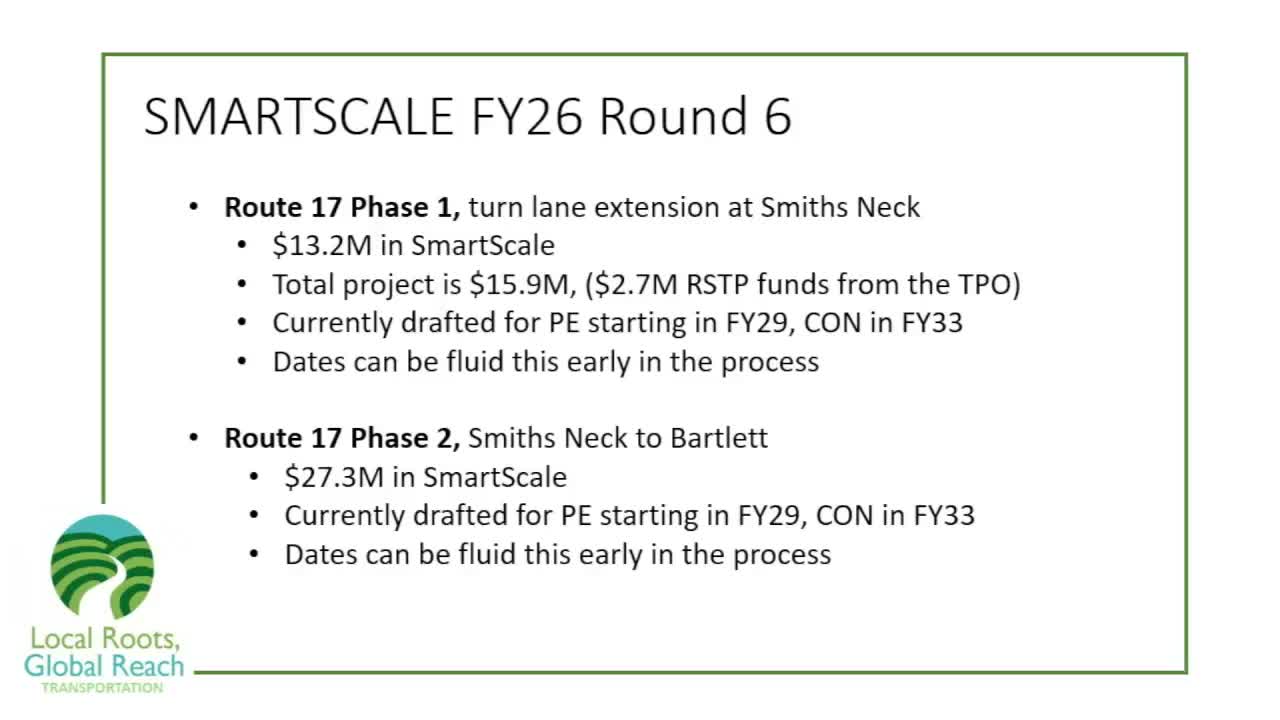
Isle of Wight County staff reported the Commonwealth Transportation Board recommended both Route 17 widening projects for Smart Scale funding. Staff explained the two-phase project approach, funding packaging and the role of prior regional RSTP funds toward phase 1.
County transportation staff told the Board of Supervisors that the Commonwealth Transportation Board’s Smart Scale draft funding scenario recommended funding two Route 17 widening projects the county submitted for Round 6.
Why it matters: Smart Scale is a competitive statewide program that provides grants for transportation projects. County staff said the recommendation places both Route 17 phases into the draft plan and that final adoption will occur when VDOT adopts its combined six‑year improvement plan.
Details presented
Jamie Oliver, transportation administrator, described the two‑phase concept: phase 1 would lengthen and improve the existing turn lane at Smith’s Neck Road and provide right‑of‑way, utility relocation and drainage work; phase 2 would convert the extended turn lane into a through lane to complete the widening toward the Bartlett intersection and add a new right‑turn lane at Smith’s Neck.
Staff explained the county had previously set aside roughly $2.7 million in RSTP funds from the regional TPO and applied for an additional ~$3.2 million Smart Scale request to close a funding gap for phase 1. Jamie Oliver said phase 1 was effectively fully funded by combining the county’s RSTP allocation and the Smart Scale award; phase 2 was recommended for full Smart Scale funding as well.
Board and staff discussion
Supervisors asked about project termini, design timing and how Smart Scale scoring and inflation affect smaller projects. Jamie Oliver answered that the presented maps and descriptions were conceptual and that the final termini and intersection details will be determined during design; she said Smart Scale requires a high level of pre‑application engineering, cost estimating, environmental screening and right‑of‑way analysis and noted that smaller projects can be disadvantaged by inflated long‑range cost estimates.
Ending
Staff said design and right‑of‑way work would proceed and that final Smart Scale funding will be confirmed when VDOT adopts its full six‑year plan. Transportation staff advised the board that receiving Smart Scale awards often requires earlier investment in design and right‑of‑way work to meet program requirements.