Get Full Government Meeting Transcripts, Videos, & Alerts Forever!
Get email alerts on the Climate Budget topic
No spam. Unsubscribe anytime.
Denver office lays out 2026 climate budget, shifts staff and funds to voter-approved climate protection fund
Summary
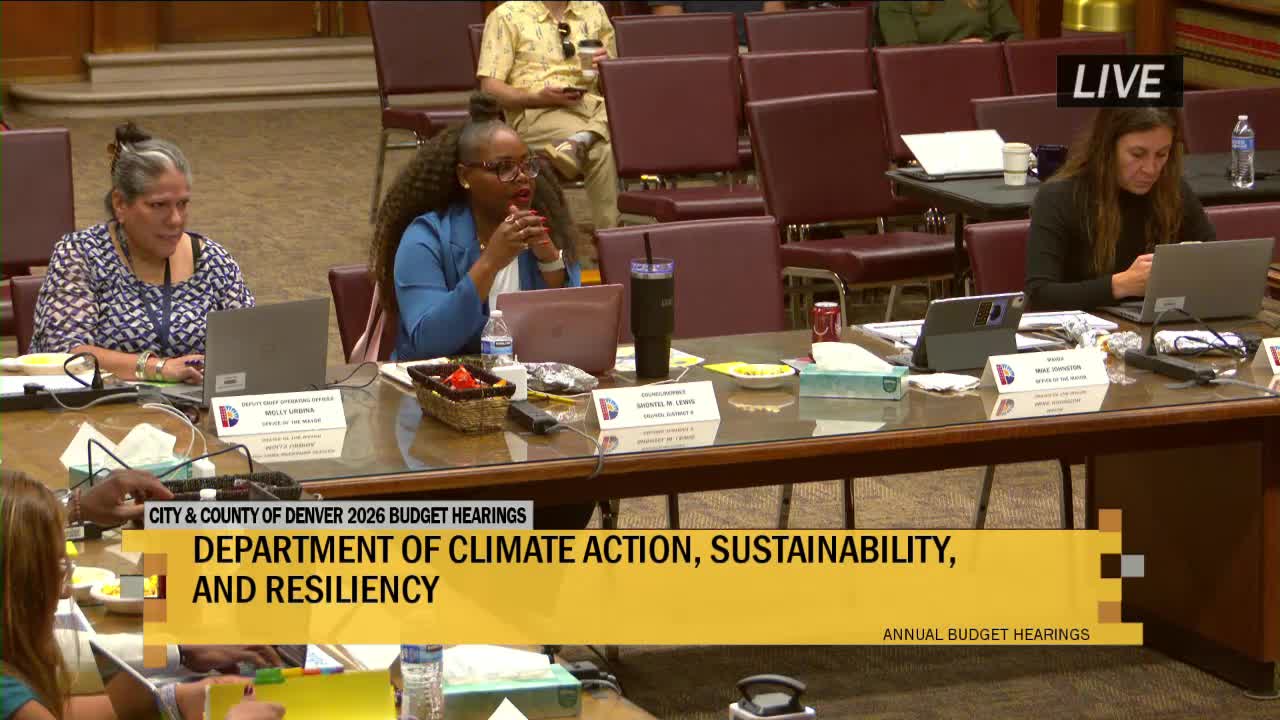
Denver’s Office of Climate Action, Sustainability and Resiliency on Wednesday told the City Council it will preserve core community programs in 2026 while realigning staff and many program costs into the voter‑approved Climate Protection Fund and delaying some new initiatives pending a program redesign.
Denver’s Office of Climate Action, Sustainability and Resiliency on Wednesday told the City Council it will preserve its core community programs in 2026 while realigning staff and many program costs into the voter‑approved Climate Protection Fund and delaying some newly planned initiatives pending a program redesign.
"We really believe that the climate crisis is solvable and together, we're the ones to do it," Liz Babcock, executive director of CASR, told the council. Babcock framed the office’s 2026 priorities as carbon pollution reduction, climate adaptation and resilience, zero waste and circularity, equity and climate justice, and communications and engagement.
The presentation explained why CASR is moving personnel and program costs into the Climate Protection Fund, a voter‑approved fund whose projected 2026 revenue the office estimates at approximately $52,000,000. CASR’s operating budget from that fund for 2026 is listed as about $38,800,000, with roughly $13,000,000 shown as a capital transfer to support rooftop and community solar, EV charging and facility electrification.
CASR said the office will preserve public‑facing services residents know — including e‑bike rebates, electrification and EV charging rebates, tree‑planting in low‑canopy neighborhoods, and the Healthy Homes and community solar programs — even as it trims vacancies and eliminates positions that were never filled. The office reported eliminating 13 vacant positions funded by the Climate Protection Fund, 1.5 filled positions in a layoff category funded by the climate fund, and reducing 7.25 vacant positions and 3.5 filled positions in the general fund. Babcock said many vacancies had never been filled as the office matured since its creation.
CASR acknowledged delays to some initiatives the office had planned while it streamlined program delivery through a single contractor portal and consolidated smaller mini‑grant contracts. Babcock said the public portal and program redesign are under internal testing and will launch in 2026; the redesign aims to let nonprofits, small businesses and residents apply through one pathway rather than multiple separate applications. She listed the Food and Climate Justice program and the Community Climate Ambassadors program among items delayed but intended to move forward once RFP awards are completed.
The office highlighted several specific capital and pilot investments for 2026, including a $4,200,000 pilot to connect a city facility to a chilled‑water ambient loop using water‑source heat pumps as a proof of concept, and about $2,700,000 for electrified mobility improvements and $8,450,000 for energy efficiency and electrification in city buildings. Babcock also cited near $900,000 investments in electrification for the Westwood Recreation Center and for the Colorado Coalition for the Homeless Forum Apartments in prior years.
CASR briefed councilmembers on contracts that support its work: a new contract with APTIM to streamline rebates and mini grants (total contract value discussed as $23,100,000 with expected 2026 spend of about $8,000,000), McKinstry contracts for community solar development and subscriptions, Touchstone for benchmarking support, and Spark for rooftop solar design and installation. Babcock said McKinstry will also manage bill credit assignments for community solar subscribers and maintain projects over long terms.
On workforce and equity, CASR said the ordinance creating the office requires equity integration; the agency listed a $1,000,000 allocation in 2026 for workforce development in clean energy and natural resources (in partnership with DETO), and described programs targeting equity‑priority buildings (multifamily affordable housing, commercial and nonprofit buildings over 25,000 square feet) for enhanced technical support and higher‑value rebates.
Councilmembers pressed CASR on several points during the Q&A: why some staff had not been initially placed on the Climate Protection Fund (Babcock said the fund did not exist at the office’s creation and staff were hired on the general fund first), requests for an organizational chart showing which positions moved to which fund (Babcock agreed to provide one), and questions about state and federal grant opportunities for fleet electrification (Babcock said the office has secured some state grants, typically in the low‑hundreds of thousands for targeted charging installations).
Waste No More, the city’s recent commercial and institutional waste ordinance, remains in CASR’s general fund work because the climate fund does not allow those uses. CASR said it retained a core team within the general fund to lead outreach and education for implementation and will also draw on the disposable bag fee fund for some support. Babcock said the office expects to rely on community partners for outreach and emphasized the scale of the implementation challenge.
Councilmembers asked technical questions about the ambient loop pilot, coordination with Xcel Energy (referred to in the meeting as "Excel"), and how CASR will use pilot results to inform advocacy at the Colorado Public Utilities Commission. Babcock said the proof of concept is intended to reduce reliance on downtown substations over time, lower long‑term utility costs and water use compared with the aging steam loop, and yield evidence the city can bring to regulators.
The presentation closed with CASR offering to provide council offices with more granular data and maps showing rebate distribution and contract spending. Babcock said CASR will move forward with program awards that had been paused and will launch the redesigned public portal in 2026.
Questions from the council and the office’s answers occurred during the CASR budget presentation portion of the hearing; no formal council votes on ordinance language or budget allocations were recorded during this exchange.