Get AI Briefings, Transcripts & Alerts on Local & National Government Meetings — Forever.
Initiative 83: voters backed ranked choice and semi‑open primaries; witnesses press BOE and OCF on petition verification, implementation funding and dark‑money
Summary
At a Feb. 19 oversight hearing, civic groups and campaign advocates pressed election and campaign‑finance officials over petition verification standards, alleged use of whiteout on Initiative 83 pages, outside campaign funding, and the money needed to implement ranked‑choice voting and semi‑open primaries.
What happened: On Feb. 19 the Committee on Executive Administration and Labor heard extended public testimony on the aftermath of Initiative 83 — the citizen referendum that would implement ranked‑choice voting and allow independents to vote in taxpayer‑funded primaries — and on how the Board of Elections (BOE) and the Office of Campaign Finance (OCF) handled petition verification, funding, and related legal challenges.
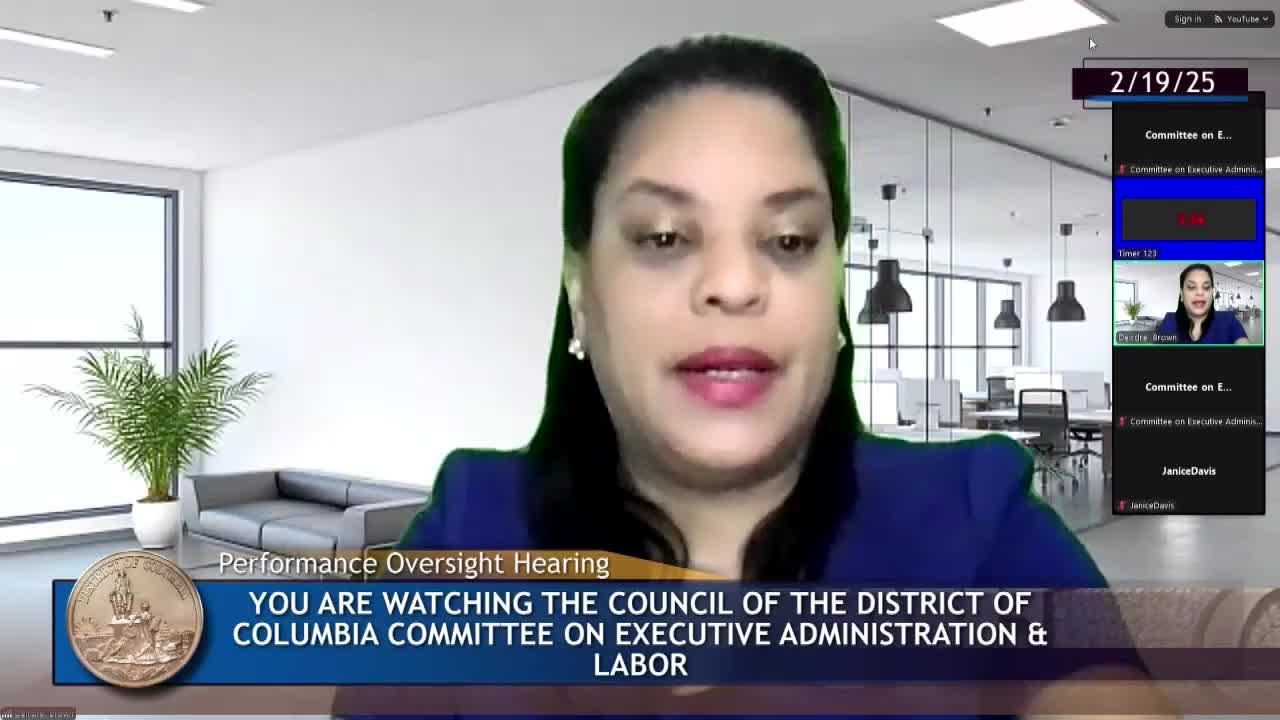
Petition verification and whiteout: Deirdre Brown, legislative committee co‑chair of the Metropolitan Women’s Democratic Club, told the committee she observed “numerous instances where whiteout had been applied to voter signatures, addresses, and circulated affidavits” during Initiative 83’s petition verification. Brown said BOE acknowledged 4,802 signatures were invalidated for whiteout, but she told the committee “thousands more were altered” and expressed concern about inconsistent standards — for example, staff “holding pages to the light” to judge voter intent. Brown asked for an independent review, clearer written rules prohibiting whiteout, and more uniform enforcement.
Other civic witnesses echoed those concerns. Janice Haines Davis of the D.C. Federation of Democratic Women told the committee the city should delay implementing Initiative 83 until funding for voter education is available and until courts have resolved legal disputes. Hazel Bland Thomas pressed the committee about disclosure and “dark money” in the I‑83 campaign, saying roughly “80% of the contributions came from organizations that were not required to reveal the names of their principal donors” and listing national organizations she said provided the bulk of outside funding.
Supporters call for funding and education: Proponents of Initiative 83 — including Lisa Rice (the initiative’s proponent), Brianna McGowan and Jacqueline Castaneda from Rank the Vote DC — urged the Council to fund implementation, particularly voter education. Witnesses cited a range of estimates for voter‑education costs; one witness described the fiscal impact statement as showing most costs are for voter education (an often‑cited figure in testimony was roughly $1.15 million for materials, with other witnesses saying $1.5 million or more would be prudent). Witnesses emphasized that the initiative won with more than 70% support citywide and urged the Council to honor the will of voters by budgeting for implementation now.
BOE and legal status: BOE Executive Director Monica Evans explained the board’s legal position and summarized several court actions related to Initiative 83. Evans said the D.C. Court of Appeals refused an emergency stay that would have kept the measure off the ballot, and she described cases that have been remanded to D.C. Superior Court for merits review. Evans told the committee: “There was no basis upon which we should not go forward” when the board placed the initiative on the ballot, and she noted the appeals court had found petition challengers had not demonstrated irreparable harm.
OCF and public financing implications: William Sanford, general counsel at the Office of Campaign Finance (speaking for the director), reviewed the fair elections program costs and the agency’s planning for the 2026 election cycle. Sanford told the committee OCF had authorized $2,830,041.15 in disbursements for certified fair‑elections candidates in 2024 and that the agency’s projection for the 2026 cycle is $32,365,053 (spread across FY25–FY27) to fully fund fair elections for the covered offices, while acknowledging the FY25 appropriation was $3 million and noting a carryover balance that could be used with council approval. OCF also signaled it plans proposed rule and statutory changes intended to make verification and enforcement more uniform.
Why this matters: Petition validation procedures, signature‑review standards and enforcement practices determine whether a measure reaches the ballot and whether petitioners or challengers have fair and transparent processes. Voter education funding affects whether a major change to voting methods — ranked‑choice voting — will be implemented successfully. The presence of significant out‑of‑jurisdiction funding renewed calls for greater disclosure and tighter campaign‑finance rules.
Quotes
"The Board of Elections acknowledged that at least 4,802 signatures were invalidated due to whiteout," — Deirdre Brown, Metropolitan Women’s Democratic Club.
"The agency authorized a disbursement of a total sum of $2,830,041.15 from the elections fund...to 20 certified FEP candidates," — William Sanford, Office of Campaign Finance (on 2024 fair elections disbursements).
"The Court of Appeals on August 30 noted ... the petitioner failed to show a risk of irreparable harm..." — Monica Evans, D.C. Board of Elections (summarizing appeals court ruling on Initiative 83 challenges).
Ending
Witnesses urged the Council to adopt clearer petition rules, require uniform enforcement, and fund robust voter education so voters understand ranked choice voting before implementation. BOE and OCF told the committee they will publish reports and proposed rule changes and asked the Council to consider funding to support implementation and auditing. The committee requested follow‑up information from both agencies on the whiteout counts, litigation status, and cost projections for implementing Initiative 83.