Lifetime Citizen Portal Access — AI Briefings, Alerts & Unlimited Follows
Xcel Energy tells Colorado Forest Health Council it has invested about $500 million in wildfire mitigation; highlights cameras, clearing and access challenges
Loading...
Summary
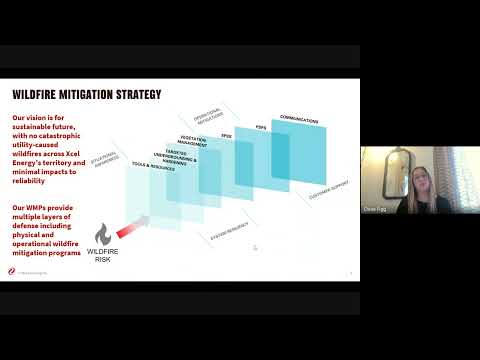
Xcel Energy representatives told the Colorado Forest Health Council Legislative Committee on a virtual briefing that the utility has invested about $500,000,000 in wildfire-mitigation activities in Colorado over the past five years and described how that money has been directed toward system hardening, vegetation work and situational-awareness tools.
Xcel Energy representatives told the Colorado Forest Health Council Legislative Committee on a virtual briefing that the utility has invested about $500,000,000 in wildfire-mitigation activities in Colorado over the past five years and described how that money has been directed toward system hardening, vegetation work and situational-awareness tools.
"We have invested over $500,000,000 in wildfire mitigation activities in the state," said Chloe Fig, state government affairs manager for Xcel Energy, describing investments funded largely through customer dollars and the utility’s wildfire mitigation plan. Fig said she would provide a more detailed breakdown of the investments after the meeting.
Michael Hayden, Xcel’s director of situational awareness, described a multi-layered approach that includes AI-enabled cameras and wildfire modeling (Technosilva) that run 24/7 to detect smoke, monitor forest conditions and inform public-safety partners. "These are AI enabled — they’re looking for smoke 24 hours a day," Hayden said, adding that algorithms distinguish smoke from benign sources and that the company shares relevant alerts with local fire departments and other partners.
Commissioners raised privacy and data-retention questions. "When you talk about partners and who's selling the data, where is the data going?" asked Commissioner Jody Shattuck McNally. Hayden said sensitive imagery is pixelated, data is reviewed under legal controls, and most raw camera data is only retained on-site for 24 hours with a small catalog kept off-site for about 30 days "because it's too much information to hold on to." He said the cameras are owned by Xcel and are used only for wildfire purposes.
On vegetation management, Nick D'Amico, Xcel’s manager of vegetation management, described four main programs in the utility’s mitigation plan: corridor maintenance, right-of-way clearance, wildfire hazard-tree removal and defensible space. D'Amico said corridor maintenance aims to maintain at least four feet of clearance from energized conductors at all times and that field crews prune to 10 feet during maintenance to allow regrowth without breaching the four-foot minimum. "By 2025, we will have completed this on about 70% of all of those corridors," he said.
D'Amico said the current revisit cadence for corridor maintenance is roughly four years but that Xcel is moving toward condition-based management using satellite imagery and other geospatial tools. He also said the company prefers full tree removal where trees will repeatedly regrow, but it requires property-owner acknowledgement before removing private trees. "If in that conversation someone says, sure, I want you to cut down a tree, but I don't want any of that wood, we now have the ability to haul all that material away," D'Amico said.
Committee members pressed Xcel on operational and permitting barriers. Commissioner Mark Morgan and others said narrow, aging forest roads, rolling dips and tight curve radii often prevent heavy machinery and lowboy trailers from reaching treatment sites. "A lot of rolling dips in this kind of design ... preclude about two-thirds of heavy-equipment transport," Morgan said. Xcel acknowledged the problem and said improved coordination with federal land managers and clearer engineering standards for access would help.
The meeting also covered potential strategies to expand mitigation beyond strict easement lines — sometimes called "feathering" — and discussed the limits of what the utility can do outside its legal right-of-way. Xcel staff said they are open to collaboration with agencies such as the U.S. Forest Service and the Bureau of Land Management when projects align with ratepayer benefit and legal authority.
On operational tactics, Fig described two operational settings used to reduce ignitions: Enhanced Power Line Safety Settings (EPSS), which make lines more sensitive and can increase de-energization and inspection time after an event, and Public Safety Power Shutoffs (PSPS) as a last resort. "After a PSPS, our priority is to restore power safely and quickly, but restoration can only begin after winds and wildfire risk have subsided," Fig said.
Committee business: earlier in the meeting the committee moved and seconded to approve the minutes presented; the chair called for the vote and recorded unanimous "Aye" responses on the audio call. The committee also discussed scheduling and a January 29 breakfast event; the chair later called for a motion to adjourn, which carried by voice vote.
The presentation highlighted operational tradeoffs — such as equipment access, property-owner consent and data privacy — that the council said may merit legislative attention. Several commissioners suggested exploring modest statutory or administrative changes to streamline federal-use agreements, clarify access and encourage projects that both reduce wildfire risk and support the utility grid. The council asked Xcel to provide the slide deck and detailed answers to the five pre-submitted questions for committee follow-up.