Get AI Briefings, Transcripts & Alerts on Local & National Government Meetings — Forever.
DeKalb staff present draft data center zoning rules; commissioners ask for enforcement and GIS detail
Summary
Planning staff unveiled a draft text amendment to regulate data centers, proposing permitted locations, special land use permit requirements, height and sustainability incentives, noise and generator limits and decommissioning plans; commissioners asked for clearer enforcement mechanisms, GIS maps and separate energy/water sustainability metrics.
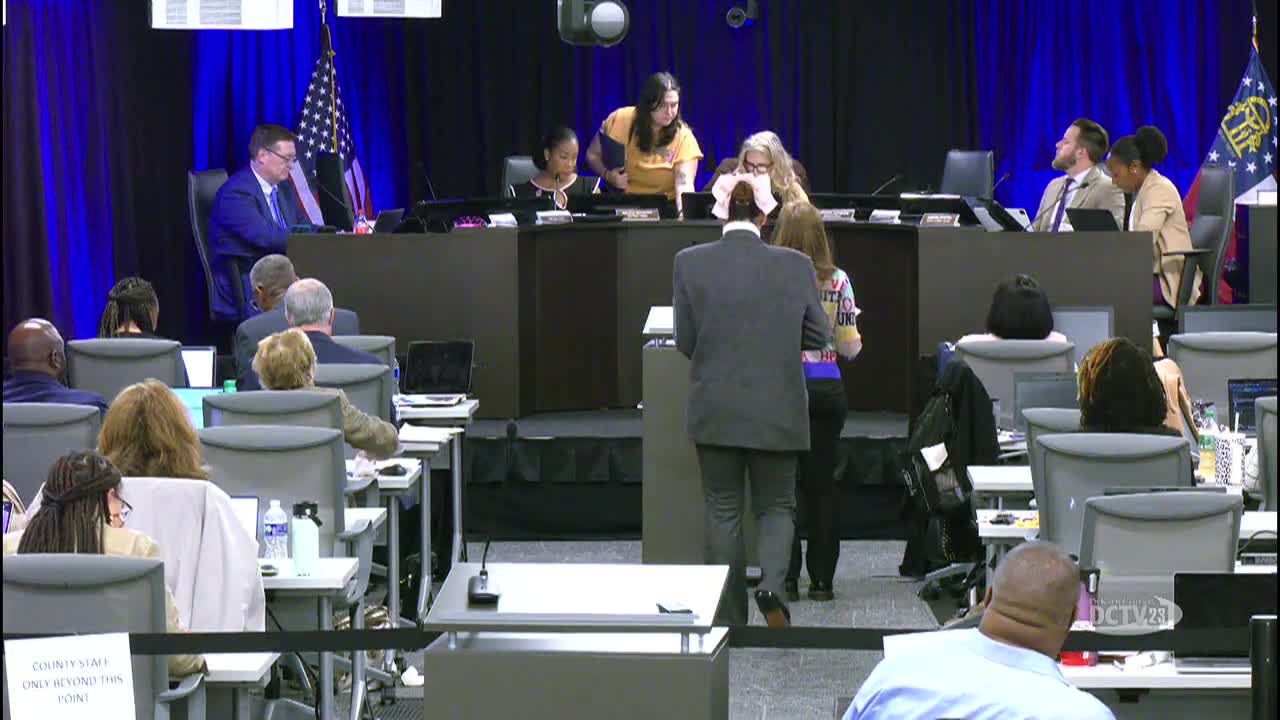
DeKalb County planning staff presented Nov. 1 a comprehensive draft text amendment that would establish land-use regulations for data centers, including where they can locate, mandatory application studies, architectural and screening standards, noise and generator testing limits, and sustainability incentives tied to building height.
Major proposals include permitting smaller data centers in office/industrial districts with a special land use permit (SLUP), a 500-foot buffer for heavy/light industrial uses from residential zoning (reduced to 300 feet where properties border an interstate or major arterial), a maximum building height of 75 feet (plus up to 30 feet of rooftop equipment) with a potential increase to 150 feet if a project offsets 45% of its energy/water use through renewables or efficiency measures, and a requirement that generators meet at least EPA Tier 3 emission standards with testing limited to 10 hours per month.
Planning staff said the SLUP will require transparency documents including noise impact assessments, water- and energy-consumption/sustainability plans, transmission-line impact assessments and tree-preservation/reforestation plans, and added a decommissioning plan requirement. Staff also proposed allowing redevelopment of existing industrial sites without a new SLUP to encourage adaptive reuse.
Commissioners and staff discussed enforcement and inspection mechanisms repeatedly: several commissioners asked staff to identify which county office will enforce generator testing and noise limits and to include a mechanism for ongoing, auditable logs (for example, remote automated test logs), as well as GIS maps planners used to size buffers. Commissioners also suggested separating on-site water-saving measures from off-site renewable energy offsets when calculating incentives, and one commissioner proposed a requirement for visible public art or murals on buildings in prominent locations.
Planning staff said they would refine the draft, provide GIS layers and maps, clarify enforcement responsibilities and consider splitting the 45% offset metric into distinct energy and water components before the proposal goes to Planning Commission on Nov. 6 and the Board of Commissioners on Nov. 20.