Get AI Briefings, Transcripts & Alerts on Local & National Government Meetings — Forever.
What Propositions G and H would change about San Francisco police oversight
Loading...
Summary
City Attorney Tom Owen briefed the Police Commission on two November charter amendments: Proposition G would reorganize and rename the OCC as the Department of Police Accountability and change budgeting and audit authority; Proposition H would create an elected Public Advocate with appointment powers in certain scenarios.
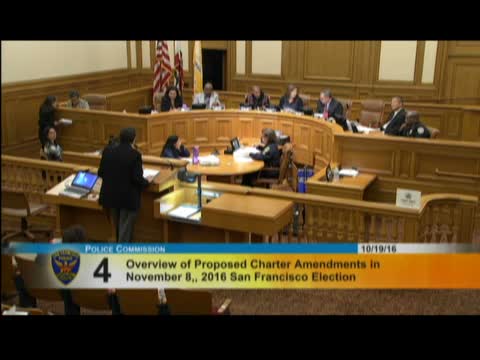
Tom Owen of the City Attorney—s Office gave an informational briefing on Oct. 19 summarizing two proposed charter amendments on the November ballot that would reshape local police oversight structures if approved by voters. Owen emphasized that the commission could not advocate for or against ballot measures during the informational briefing.
Proposition G, as Owen described it, would rename the Office of Citizen Complaints (OCC) to the "Department of Police Accountability" (DPA), relocate OCC/DPA provisions to a new dedicated charter section, clarify DPA access to relevant city records, require the DPA to conduct a performance audit of police use of force every two years, and allow the DPA to make some audit results available to the public "to the extent permitted by law." Crucially, Proposition G would also permit the DPA budget to be prepared and submitted separately from the police department budget and to be submitted directly to the mayor rather than requiring police commission review of the DPA budget. Owen said the current director would continue to serve unless removed or resigning.
Proposition H would create an elected Public Advocate with duties to investigate and attempt to resolve complaints about city services, receive certain whistleblower complaints and generally review city administration and contracting. If Proposition H passed, the Public Advocate would appoint the director of the OCC/DPA (from nominees supplied by the Police Commission) subject to Board of Supervisors approval; if both measures pass, those provisions interact so the Public Advocate would appoint the next director of the DPA. Owen also noted state law protections for personnel records (including POBRA) would remain in place and limit disclosure in some audits.
Why it matters: both measures alter the appointment and budget submission processes for the agency that oversees police misconduct investigations. Commissioners asked how state privacy laws would affect proposed audits and whether the measures would change the OCC/DPA—s reporting relationship with the Police Commission. Owen said the DPA (or OCC if G fails) would still be overseen by the Police Commission and would continue to be accountable to it for discipline and investigatory work, though budget and appointment procedures would differ under the proposals.
What happens next: Owen fielded questions and reiterated the presentation was informational because the commission cannot weigh in on pending ballot measures during this meeting; commissioners and staff said they would follow the measures' results and incorporate any changes into future commission and department planning.