Get Full Government Meeting Transcripts, Videos, & Alerts Forever!
Get email alerts on the Parks And Recreation topic
No spam. Unsubscribe anytime.
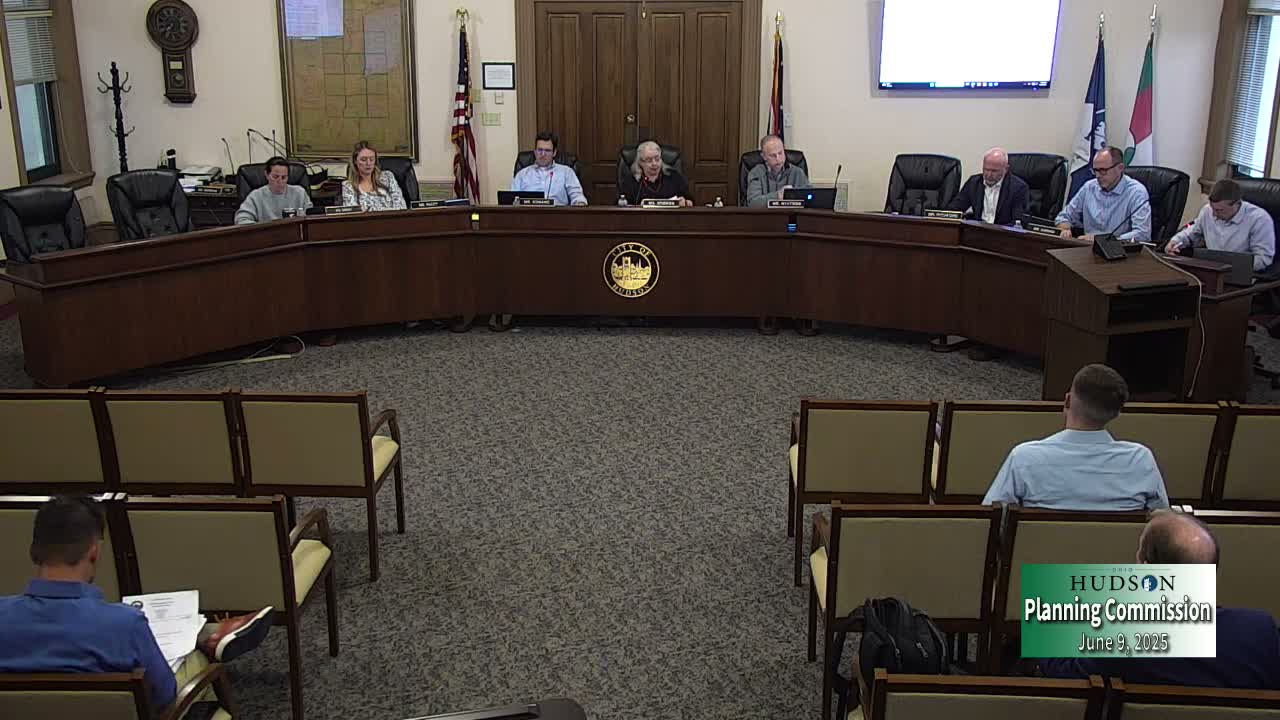
Hudson planning commission approves turf field and restroom for Christ Community Chapel with conditions
Summary
The Hudson Planning Commission approved a conditional-use/site-plan permitting Christ Community Chapel to replace an existing grass athletic field with synthetic turf, install a walking path with low lighting and a 398 sq ft detached restroom building; approval (5–0) is conditional on a BZBA variance for the restroom location, ARC design review and several staff requirements.
The Hudson Planning Commission on June 9 approved a conditional-use permit and site plan for Christ Community Chapel to replace an existing grass soccer field with synthetic turf, add a walking path with low-level lighting and construct a 398-square-foot detached restroom building. The commission voted 5–0 to approve the project subject to staff recommendations and a variance requirement for the restroom’s side-yard location.
The project, which was continued from April, proposes turf to improve drainage and usability after rain, a 3.5-foot-high pathway light system that the applicant said would be set to turn off at 10:00 p.m., and a restroom building with three single-user rooms so the playground and field users do not need access to the main church building. Architect Matthew Sutter said the church is not changing the function of the space but “we’re really just asking for three things here tonight” — turf, a walking path and on-site restrooms — and emphasized safety and reduced maintenance as key benefits.
Lead pastor Zach Weihrach framed the project as community-focused, saying the upgrades would help “demystify” the church property and function as “a third space” for neighbors. Jimmy Cozzi, speaking for the church’s programming team, told the commission the site is already used for public, free programming and that the standalone restroom would reduce reliance on temporary portable toilets.
Commissioners raised technical concerns before the vote, including fence height, setback and the restroom’s location in a side yard. Staff recommended approval conditioned on: (1) submitting and obtaining any necessary variance from the Board of Zoning and Building Appeals to locate the restroom in the side yard; (2) ARC (Architectural Review Committee) review of restroom and fencing design; (3) revised landscaping to widen the Terex Road buffer to a consistent 50-foot width; (4) addressing the assistant city engineer’s comments in the June 2 correspondence; (5) installing silt or polypropylene fencing to mark clearing limits; (6) satisfying conditions before a pre-construction meeting and issuance of a zoning certificate; and (7) the applicant’s option to seek a variance from BZBA for any fence taller than 4 feet.
The record contains staff and applicant noise readings and stormwater analyses: staff and applicant confirmed turf counts as impervious surface for stormwater calculations; the applicant presented decibel readings taken nearby (ambient 68–88 dB, recreational field readings roughly 77–90 dB) and said the nearest house is about 750 feet away and the field sits approximately 14 feet lower than the nearest residential first floor. The commission also asked the applicant to correct a noted scale issue on civil drawings and to continue neighborhood outreach (applicant noted a neighbor meeting scheduled for June 24).
Next steps: staff will incorporate the commission’s conditions into written findings of fact and the applicant must obtain any BZBA variances before construction and a zoning certificate is issued.