Get Full Government Meeting Transcripts, Videos, & Alerts Forever!
Get email alerts on the Capitol Acoustics And Wayfinding topic
No spam. Unsubscribe anytime.
Subcommittee reviews construction documents for Capitol wayfinding, acoustics and broadcast studio
Summary
Consultants presented first-pass construction documents for the Capitol interpretive exhibits and wayfinding project, outlined a mock-up and testing plan to reduce fan-coil noise, proposed alternatives for chamber acoustic treatments (drapery vs. ceiling), and described plans for a 50% design and first cost estimate.
Consultants for the Capitol Interpretive Exhibits and Wayfinding Subcommittee presented initial construction documents and scoping drawings and described near-term tests to reduce noise from fan-coil units, options for chamber acoustic treatments and planned next steps toward a 50% design and cost estimate.
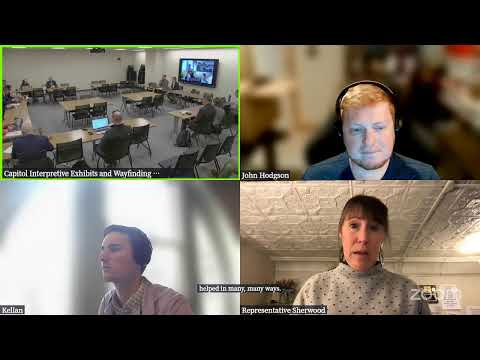
The project team said the current packet is an early construction-document submittal—between schematic design and design development—focused on layouts, reflected-ceiling plans and elevations. “This is more of an update for us, to share with you kinda where we're at,” the presenter said as the team introduced Todd Ranier (project manager, Trainer), Zach Cornes (project architect, Trainer), Kellen Horner (MEP engineer, Henderson Engineers) and John Hodgson (project acoustic engineer, Yvonne).
Why it matters: the scope affects chamber acoustics, public meeting rooms, and a proposed broadcast studio, with implications for visitor experience, legislative proceedings and media production inside the Capitol.
Key details
- Fan-coil mock-up and testing: The team proposed a pre- and post-test mock-up of a representative fan-coil unit to establish a baseline and measure improvements after mitigation measures (duct liner, internal baffles and control changes such as a temperature dead band and running units in parallel). Consultants said they will engage a third-party contractor to perform accelerated testing, and will return results to the subcommittee for evaluation. The team estimated the initial mock-up/fix would cost about $1,000–$2,000 and take one to two days to install and tune; testing is expected after the new year.
- Broadcast studio changes: The plan would enlarge the existing studio by demoing adjacent partitions, add acoustic treatment in smaller workrooms and install acoustic doors. The design team identified unresolved equipment decisions—cyclorama and pipe grid placement—and noted they will coordinate with PBS (a past project partner) and trades to ensure maintenance access and appropriate cooling for a high-heat server housed in the studio workroom.
- Chamber acoustics: For the Senate chamber the team presented an ad-alternate: acoustic drapery (lower cost but visually conspicuous) versus an extended ceiling treatment (more visually integrated but costlier). Both alternatives will be carried through detailed design and included in bidding as alternates so the committee can decide after pricing. The House chamber lacks the option for drapery and would receive extended ceiling treatment.
- Railings and gallery work: The packet proposes removing reflective glass railings in chambers and replacing them with bronze railings (described in the documents as Julius Bloom bronze) to reduce sound reflection. In smaller meeting rooms such as the JAC, the team prefers wall-absorption treatments to protect decorative ceilings.
Next steps and process
Consultants said the next formal deliverable is a 50% review that will add profiles, decorative paint details, specifications and the first contractor-based cost estimate. The team will carry both acoustic alternatives through to 100% design for bidding; the bid results will inform the committee’s preference between drapery and ceiling treatment. The mock-up testing results for fan-coil units will be brought back to the subcommittee for a decision about wider application and major maintenance rollouts.
Meeting context and quotes
The packet was presented as a scoping set rather than a finished specification package; presenters emphasized the documents are intended to move the project into bidding and to create decision points for the subcommittee as pricing and test data arrive.
Administrative note
A committee member announced that the Wyoming Capitol’s National Historic Landmark renewal was signed by the Secretary of the Interior during the meeting period; the team and committee framed that news as helpful context for careful treatment of historic finishes during any ceiling or rail modifications.
The subcommittee did not take formal votes during this session. The project team will return with test results, 50% design documents and a cost estimate for committee review.