Get Full Government Meeting Transcripts, Videos, & Alerts Forever!
Get email alerts on the Bed Bugs topic
No spam. Unsubscribe anytime.
San Francisco officials and tenants press for stronger enforcement as bed‑bug complaints rise
Summary
A hearing of the Building Inspection Commission brought a detailed Department of Public Health briefing and more than two dozen public comments outlining gaps in enforcement, limited tenant assistance, and calls for coordinated city action and funding. DPH and DBI said they will pursue stronger enforcement, outreach and interagency coordination.
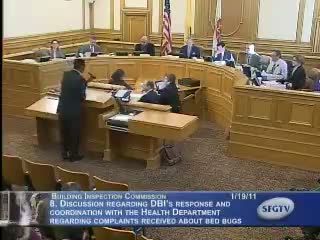
San Francisco’s Building Inspection Commission spent the bulk of a meeting focused on bed‑bug complaints, receiving a detailed briefing from Department of Public Health staff and sustained testimony from tenants and community groups who said existing rules are not being enforced reliably.
John Sinojo, representing the Department of Public Health, told commissioners that bed bugs have re‑emerged in recent decades and are now reported citywide in shelters, single‑room occupancy hotels (SROs), apartments and private homes. He described DPH’s inspection and enforcement pipeline: complaints are logged, assigned to environmental health inspectors and, when bed bugs are confirmed, the department issues notices of violation and may escalate to citations or a director’s hearing if owners do not comply.
“Bed bugs are not known to transmit any disease to man,” Sinojo said, while noting that bites can cause allergic reactions and secondary infections for some residents and that treatments require careful room preparation and multiple follow‑up visits to be effective. He also said DPH administers about $63,000 in assistance to community‑based groups that help tenants prepare units for treatment and that some collaboratives receive smaller, targeted grants (one collaborative said it receives $20,000 for laundry services).
Why it matters: Tenants, tenant advocates and SRO collaboratives told the commission that the city’s written protocols are not being implemented consistently at the building level. Speakers described managers who hire unlicensed pest control operators or provide only one treatment when protocol calls for three; lease addenda that seemingly strip tenant protections; and the practical barriers frail, elderly or disabled residents face when units must be emptied and items bagged for treatment.
Danette Lambert of the Central City SRO Collaborative said her office sees about 300 drop‑ins per month and that bed bugs are consistently among tenants’ top concerns. “When the protocol is followed correctly, bed bugs have a greater chance of being abated,” she said, but added that many managers “are not using licensed pest control companies” and that re‑inspections and second and third treatments often do not occur.
Multiple tenants described health impacts and financial strain: one tenant said he withheld rent to force treatment and to recover personal property; another said heat treatment was delayed or unaffordable and that pesticide treatments had failed to clear his unit.
City response and next steps: DBI’s Chief Housing Inspector, Rosemarie Boske, explained the overlapping jurisdiction: bed‑bug infestations appear in Chapter 10 and Chapter 13 of the San Francisco Housing Code and are handled by DPH when complaints concern bed bugs exclusively; DBI will handle bed‑bug findings when they arise alongside other code violations. Boske said DBI and DPH conduct joint room‑to‑room inspections in residential hotels and may use civil penalties against property owners who fail to comply with rules and regulations.
Commissioners and staff acknowledged capacity limits: DPH representatives said a small inspection staff covers hundreds of hotels and that more training for pest control operators is needed. Several commissioners urged better coordination with Adult Protective Services and community collaboratives to assist tenants who cannot prepare rooms themselves; DPH said it refers qualifying clients to APS or to community organizations that receive city funds for assistance.
A number of speakers urged more aggressive enforcement tools and clearer oversight of pest control companies. The commission and staff agreed to continue coordination with supervisors’ offices, SRO collaboratives and the SRO task force to pursue improvements in training, enforcement, and funding for tenant assistance and to consider additional staffing where feasible. Several participants also flagged the upcoming Board of Supervisors hearing on the issue.
What was not decided: The commission heard widespread testimony and identified follow‑up items (task force coordination, outreach and possible staffing or funding changes) but did not adopt new regulations at the meeting.
The commission scheduled follow‑up coordination with supervisor offices and community groups and noted the SRO task force would continue work on operational and enforcement improvements.