Get AI Briefings, Transcripts & Alerts on Local & National Government Meetings — Forever.
Niagara County official urges regional EPR for solar panels as installations grow
Loading...
Summary
Dawn Timm, Niagara County environmental coordinator, briefed Madison County lawmakers on her county’s solar-panel extended producer responsibility law — an approach she says prevents sites from becoming local waste liabilities and seeks manufacturer-funded recycling and decommissioning plans.
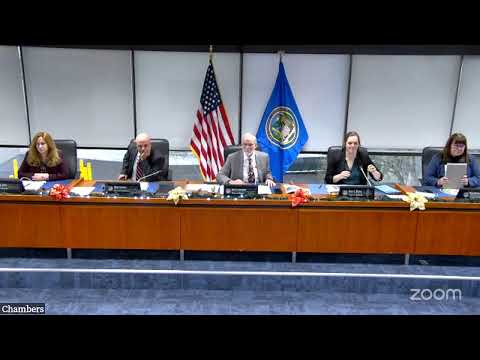
Dawn Timm, Niagara County’s environmental coordinator, told the Madison County Board of Supervisors on Dec. 12 that Niagara County adopted a local extended producer responsibility (EPR) law for solar panels and is pushing neighboring counties to consider similar rules.
“EPR for solar panels is one of the goals of New York State,” Timm said, describing the county’s law as a way to ensure manufacturers shoulder the costs of managing panels at end of life rather than local taxpayers. She said the law requires an approved plan within 30 days of equipment delivery that details financing, take-back procedures and performance targets, including a requirement that “at least 85% of the panels are going to be recycled, and 100% are going to be recovered.”
Timm said Niagara County’s ordinance, adopted in 2021, aims to prevent abandoned or insolvent projects from leaving damaged or unrecycled panels on the landscape. She described enforcement teeth in the county law — a noncompliance penalty she framed as “$100 per panel per day” — but cautioned the county has limited practical ability to collect significant fines from international manufacturers or complex supply chains.
County staff and supervisors asked about practical details. A county official asked how much remained in the Delphi Falls project contingency after proposed contract amendments; staff replied, “After this, there’ll be about $51,000.” In response to questions about recycling methods, Timm pointed to existing recyclers and pilot technologies, recommending Solar Cycle (Odessa, Texas) as one example and noting that panels contain recyclable aluminum, glass and semiconductor material that can be processed as technology develops.
Timm said Niagara County’s law was designed to separate manufacturer responsibility from installer obligations and to give the county explicit authority to require financial reserves and performance guarantees. She also described implementation challenges: installers and complicated global supply chains sometimes create loopholes, and a legal carve-out allowing producer responsibility organizations has been used by some parties to avoid manufacturer responsibility.
Timm urged a regional approach. “You get 12 counties, 12 towns, 12 anything in your state to pass a law, you’ve got attention,” she said, urging Madison County supervisors to coordinate with neighboring counties and with associations such as NYSAC (New York State Association of Counties) to share law text, consultants and implementation experience.
Supervisors raised land-use concerns, including how large utility-scale projects may affect prime farmland and local character. Timm acknowledged tradeoffs and said Niagara County tries to prioritize brownfields and other lower-value sites for utility-scale solar and to require recycling and decommissioning plans so projects do not create a future liability.
The presentation closed with questions on battery recycling and safety; Timm said lithium-ion batteries can be recycled but logistics and economics are challenging, and cautioned that battery fires require specialized response tactics. She offered to share Niagara County’s law and implementation materials with Madison County staff and to help coordinate regional workshops.
The board did not take immediate formal action on EPR at the Dec. 12 meeting. Timm said she would participate in coalition-building and follow-up through NYSAC and other county networks.