Lifetime Citizen Portal Access — AI Briefings, Alerts & Unlimited Follows
Bonner County’s Noxious Weed Director reviews 2025 work, outlines 2026 priorities; no actions taken
Loading...
Summary
At a Jan. 5 special meeting, Bonner County’s Noxious Weed Director briefed the board on 2025 treatments, budget outcomes, grant activity and plans to emphasize early detection and rapid response in 2026. The session was informational; the board took no formal actions.
The Noxious Weed Director told the Bonner County board at a Jan. 5 special meeting that the department focused last year on holding the line against several invasive plants, treating roughly 34 acres countywide and leaving the program with a modest budget cushion.
The presentation, offered in a workshop-style briefing and described by the Director as strictly informational, summarized statutory responsibilities under IDAPA 20609, treatment acreages and outreach work. “We don't have any action items on the agenda. It's just informational in nature,” the Director said as he opened the review.
Why it matters: County noxious-weed work affects road corridors, airports, riverbanks and private landowners, and can prevent costly infrastructure damage. The Director said targeted early detection and rapid response (EDRR) projects and cooperative work with regional partners help the county manage limited infestations before they spread.
Key facts and findings
- Species trends: The Director reported that Scotch broom, yellow flag iris and the large knotweed complex were holding or increasing compared with 2024, while Scotch thistle showed a net decrease. He said tansy ragwort increased overall because a newly discovered infestation appeared in a different part of the county; common reed and leafy spurge were rediscovered at very small acreages after being considered eradicated in 2024 and were treated within the season.
- Acreage and sites: The department treated about 34 acres in 2025 for listed species and recorded roughly 27.5 acres of targeted treatment on county-owned properties, with the Sandpoint Airport comprising the largest share of county-site work. The Director said the large knotweed complex totaled about 3 acres and described eradication work as scattered, often involving small, persistent patches.
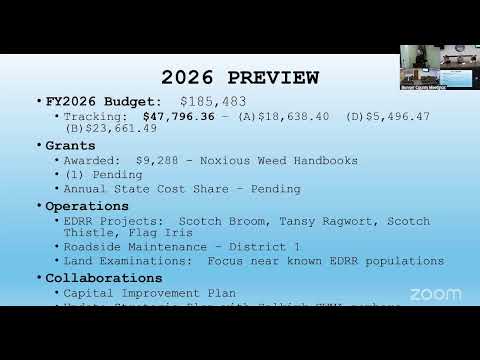
- Budget and grants: For fiscal 2025 the program was budgeted $158,182 and spent $146,287, leaving roughly an 8% cushion; cash on hand was reported just under $165,000. The department received a $7,582 state noxious-weed cost-share award and was awarded $9,288 to revise and reprint the Noxious Weed Handbook. The Director said one additional education/outreach grant is pending and that state cost-share awards should be announced in April after a February review.
- Operations and equipment: The Director described a long-standing equipment rental trade with the solid waste division (site attendants help rent herbicide application equipment to the public in exchange for vegetation control at waste sites). He detailed the county's rental sprayer—a 200-gallon pull-behind trailer with boomless nozzles and handguns—and confirmed contracted roadside spraying in Road District 2 accounted for the 257 miles figure cited for roadside maintenance last year.
- Partnerships and projects: The department worked with the Idaho State Department of Agriculture (Idaho State Dept. of Agriculture) on a jet-boat-assisted treatment of yellow flag iris along the Clark Fork River to protect Lake Pend Oreille, collaborated through the Selkirk Cooperative Weed Management Area (CWMA) on corridor projects, and partnered with the U.S. Forest Service on targeted spraying on Kalispell Island at Priest Lake. Volunteer hand-pull events and local stewardship groups also contributed to efforts.
- Outreach and training: The Director said he runs an annual weeds-and-pesticides seminar, contributes a bimonthly column to a regional cooperative newsletter, serves as a standing instructor in local Master Gardener and Master Naturalist classes, and plans to teach the University of Idaho Bonner County Master Gardener weeds class on March 12, 2026.
Quotes and board reaction
Commissioners asked clarifying questions about eradication and responsibilities. A commissioner praised the outreach work, saying community education reduces unintended spread: “Community engagement has people educating themselves on what our actual responsibility is,” the commissioner said.
The Director emphasized the county’s reliance on cooperative agreements and compliance assistance, noting statutory enforcement remains an option only when necessary: the county can serve a notice requiring eradication (eight days to comply), perform the work and invoice the landowner, and an unpaid invoice can become a lien after 90 days.
What’s next
No formal votes or motions were taken during the special meeting. The Director said he will focus on EDRR species in the coming year, finalize a roadside treatment plan for Road District 1, work with Selkirk CWMA members to update their strategic management plan, and collaborate with Commissioner Williams on a departmental capital improvement plan for FY27. Pending grant awards and state cost-share notifications are expected to return to the board on the regular agenda if and when action is required.
The Director closed by thanking the board for their time; the meeting ended at 2:56 p.m.