Get Full Government Meeting Transcripts, Videos, & Alerts Forever!
Get email alerts on the Permitting Reform topic
No spam. Unsubscribe anytime.
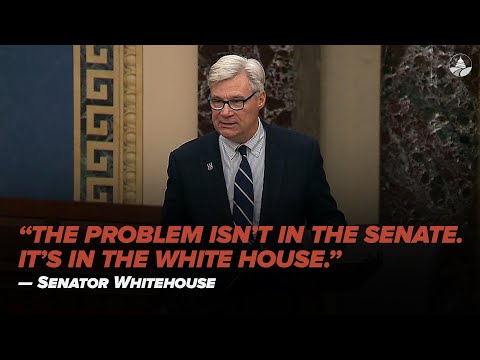
Senator pauses bipartisan permitting reform talks after Trump administration stop-work orders on offshore wind
Summary
An unnamed senator announced a pause in bipartisan permitting reform negotiations, citing repeated Trump administration stop-work orders on offshore wind projects — including a court-overturned order on Revolution Wind and a new Dec. 22 order — and said litigation and implementation uncertainty undermined confidence in enactment.
An unnamed senator told colleagues on the Senate floor that they had "declared a pause" in negotiations on a bipartisan permitting reform bill, citing repeated stop-work orders the Trump administration has issued for offshore wind projects and ongoing litigation that, the senator said, makes faithful implementation unlikely.
The senator said the Revolution Wind project off Rhode Island — described in the remarks as a roughly $4,000,000,000 investment that was "north of 80% complete" — had been forced to stop work by a White House order that a federal judge later found to be invalid on Sept. 22. The administration did not file an appeal within the 60-day window, the senator said, and work resumed; the senator added that a second stop-work order, dated Dec. 22, was later issued without explanation and was attached to the senator's remarks as an exhibit.
Why it matters: The senator said bipartisan permitting reform would be pointless if the executive branch refuses to implement its terms. The speaker framed the pause as necessary because any bill enacted by Congress would be administered by the same agencies and officials whose recent actions the senator described as "illegal, false, unfair, and biased," and therefore unlikely to deliver the expected results.
Details from the floor: The senator criticized public statements by conservative critics — naming Zeldin, Bergam and Wright and singling out Secretary Burgum's tweets and comments — saying they have falsely asserted that offshore wind raises consumers' electric bills. Drawing on sworn court filings by Ørsted, the senator said Revolution Wind's long-term contract prices are expected to act as a hedge against rising electricity costs and that pleadings estimate "hundreds of millions of dollars" in ratepayer savings over 20 years.
The senator also cited a litigation affidavit that, according to the floor remarks, characterized Revolution Wind as "a new source of low marginal cost power in New England" and quoted a grid-operator estimate saying that if the project had been online during a late-December to early-January cold snap referenced in the filings, it would have lowered regional production costs by roughly $80–85 million over two weeks and reduced charges by an estimated $11–$13 per megawatt-hour.
The speaker returned to broader implications, saying Revolution Wind had cleared the New England capacity market and emphasizing how grid operators dispatch the lowest marginal-cost units first — a point the senator used to explain why wind and solar can lower system costs. The senator warned that the administration's stop-work orders are not limited to Revolution Wind: the speaker said Dominion's offshore project is also under a stop-work order.
Appeal to industry and next steps: The senator urged technology-sector stakeholders — including companies working in artificial intelligence, crypto and large-scale data centers that need substantial power — to back permitting reform so that electricity supply decisions treat sources fairly. The senator said Senate leaders and the Republican members of the Environment and Public Works Committee, including Chair Capito and Leader Thune, had been constructive partners in crafting a bill, but that implementation failures in the executive branch were the obstacle.
Litigation is ongoing; the senator said the pause would stand until there is confidence the executive branch will implement reforms per law. No formal motion or vote on permitting legislation was recorded during the remarks.