Lifetime Citizen Portal Access — AI Briefings, Alerts & Unlimited Follows
Greene County staff outline Family Treatment Court, emphasize peers and timely reunification
Loading...
Summary
Greene County juvenile office staff described how the Family Treatment Court (FTC) uses a dedicated team, certified peer recovery specialists, and weekly dockets to support reunification for children removed for parental substance use; presenters warned the program relies heavily on grant funding.
Greene County juvenile office staff on a public presentation described how the county's Family Treatment Court (FTC) pairs families affected by parental substance use with a dedicated court team and certified peer recovery specialists to pursue timely, trauma-informed reunification.
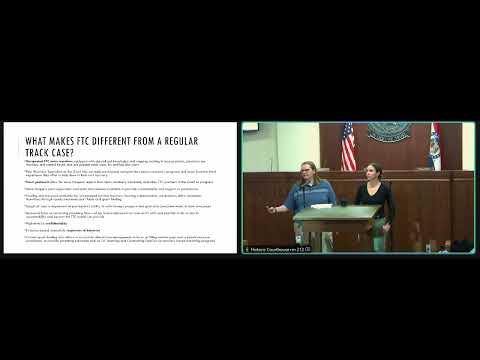
Beck Anderson, specialty courts coordinator for the Family Treatment Court with the Greene County juvenile office, said FTC focuses on families whose children entered care because of substance use and that the program is "completely evidence based" with documented effectiveness. "We staff our cases at 10:00, and then we meet with our families at 1," Anderson said, describing the court's dedicated Wednesday docket and weekly engagement.
The program emphasizes confidentiality and trust. Anderson told attendees FTC operates at the intersection of legal and medical systems and is bound by federal rules and HIPAA protections to encourage honest participation. "We're kind of in a weird position between the legal side and medical," she said, adding that confidentiality is necessary so participants feel safe to share information.
Beth Murray, clinical coordinator for the Family Treatment Court, described certified peer recovery specialists as "the kind of the heart of family treatment court." Murray said peers hold Missouri credentialing board certification, have lived experience with substance use disorder, and help participants navigate treatment, housing and basic needs. "They also help get our participants in touch with resources within the community," Murray said.
FTC is structured in five phases; participants "phase up" by presenting applications in court and complete a graduation project in later phases. Murray said the court uses contingency management to incentivize positive behavior (shout-outs, certificates, donations and "Hosmer Bucks") and nonpunitive responses—such as assignments or increased meetings—when participants struggle. "If we have a relapse, the most important thing is to come back, be honest about it, and let's get to a meeting," Murray said, noting relapse is common and part of the recovery process.
On eligibility, Anderson said FTC targets "high-risk, high-need" parents with an open abuse-and-neglect case; referrals come from Children's Division to the juvenile office for screening. Participation is voluntary: Anderson said early FTC models made participation mandatory, but the team found better outcomes when parents opt in. She noted some cases are excluded for safety reasons or severe abuse concerns and that Children's Division handles placements.
Staff described operational realities and constraints. Anderson said staff try to contact referred parents within 30 days and may allow an extra 60 days, but time standards limit how long they can hold a referral open. The program typically sees about 20 participants at a time on a Wednesday, and many staff positions are grant-funded. Murray and Anderson said FTC operates on two primary grants: one from the Office of Juvenile Justice and Delinquency Prevention and one from SAMHSA (in partnership with Murney). Murray said only two staff members are county-funded, making the program financially vulnerable if grants lapse.
Audience members asked whether FTC participation affects criminal cases; Anderson said staff write letters documenting compliance and that prosecutors, defense attorneys and probation officers may consider FTC participation in other proceedings. On whether participants who relapse may re-enter FTC, Anderson said the court reviews each case individually and that repeat entries are possible though sometimes the standard abuse-and-neglect track is the faster option for subsequent cases.
Program leads said FTC aims to reduce time children spend in foster care and to provide supports that make reunification durable. Anderson described the effort as ongoing and "a work in progress," and staff closed by noting monthly trainings for Guardian ad Litem, caseworkers and CASA volunteers to improve addiction-informed practice.
The presentation ended with a brief question-and-answer session; presenters did not announce any new funding commitments or policy changes at the session.