Get Full Government Meeting Transcripts, Videos, & Alerts Forever!
Get email alerts on the Basin Conditions topic
No spam. Unsubscribe anytime.
Ojai Basin shows recent recovery after November nadir, staff says
Summary
Agency hydrogeologist Jordan reported rising groundwater levels after a November low, citing recent rainfall and mountain-front recharge; he urged caution because DWR scoring made the basin a narrowly designated high-priority basin. The board asked for follow-up monitoring and accepted the report.
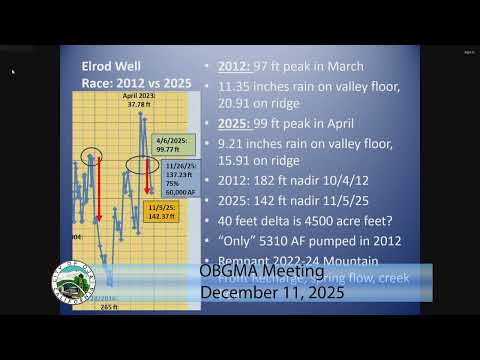
Jordan, the agency’s hydrogeologist, told the Ojai Basin Groundwater Management Agency on Dec. 11 that groundwater levels in the basin have begun to rise after a November low.
"We're at 18.35 inches on Nordoff Ridge compared to about 15 for the whole water year last year," Jordan said, noting valley-floor totals of 9.55 inches. He said the basin reached a nadir of about 142.37 feet depth-to-water on Nov. 5 and that a later reading on Nov. 26 showed about 137.23 feet, which staff estimated equates to roughly 60,000 acre-feet, or about 75% of basin capacity.
The report placed recent conditions in historical context, comparing drought-year patterns from 2012 and 2025 and emphasizing that antecedent wet years (2023–24) likely left more bedrock storage available for recharge in 2025. Jordan described monitoring results for inflows and outflows and said total measured inflow was about 1.74 cubic feet per second while surface outflow was about 3.74 CFS on the date of measurement.
Why it matters: The basin's near-term recovery affects water availability for agriculture, domestic use and the agency’s compliance obligations under the Sustainable Groundwater Management Act. Staff noted the U.S. National Weather Service/NOAA forecast through winter leaned toward slightly above-normal temperatures and somewhat below-normal precipitation.
Board members asked technical questions about lag time between storms and basin response, the performance of shallow monitoring wells, and how DWR scored the basin’s priority. Jordan said there is typically a roughly one-month lag between storms and full basin response and that additional shallow monitoring wells are planned to improve correlations between surface flow and groundwater levels.
The board did not take formal action on the report beyond directing staff to proceed with planned monitoring and to present a visual walkthrough of the DWR scoring spreadsheet at a future meeting.