Lifetime Citizen Portal Access — AI Briefings, Alerts & Unlimited Follows
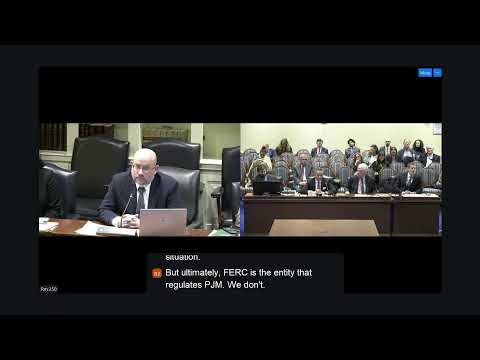
House Environment and Transportation Committee hears briefing on rising utility costs, data centers and storage plans
Loading...
Summary
PSC, the Office of People's Counsel and DNR told the House Environment and Transportation Committee that a mix of market and infrastructure factors — including recent PJM capacity price spikes and planned data‑center load — are driving higher bills; officials outlined programs and rulemakings to blunt impacts and expand storage and low‑income relief.
Members of the Maryland House Environment and Transportation Committee heard a multi‑agency energy briefing focused on why utility bills are rising and what state agencies are doing to respond.
Ben Baker, chief adviser to the Maryland Public Service Commission, outlined the PSC’s jurisdiction over distribution rates and siting and detailed ongoing work to implement the Next Generation Energy Act, solicitations for energy storage tied to a 3,000‑megawatt state storage goal, and a forthcoming large‑load tariff for hyperscale data centers. The PSC official said the commission is planning rulemakings and solicitations this year and expects awarded storage projects to take roughly 18–24 months from award to deployment.
David Lapp of the Maryland Office of People's Counsel framed the problem for residential customers. Lapp said the office has challenged recent market outcomes and is pursuing litigation and rule‑making remedies: "[A]fter that auction, we did a technical report and then filed a complaint regarding the PJM rule ... that drove up prices across the region by 800%." He and other advocates argued that inaccuracies in PJM forecasting and the interconnection queue have inflated the region’s capacity and transmission projections and can produce stranded or socialized costs if large loads do not materialize.
Kumar Barva, a longtime PSC member who spoke to the committee, told lawmakers the situation is urgent: "We are truly in the middle of a national and regional crisis when it comes to the affordability of utilities, gas, and especially electricity." He and other PSC staff emphasized demand‑side tools such as demand response, time‑of‑use rates and virtual power plants as near‑term options to reduce peak pressure and delay costly transmission or generation investments.
From the Department of Natural Resources, Bob Ciesinski of the Power Plant Research Program described a surge of solar certificate‑of‑public‑convenience and necessity (CPCN) filings: PPRP reported roughly 57 active solar cases in 2025 and dozens more in pre‑application, noting an increase in workload that has extended internal review schedules and is drawing on the program’s environmental trust fund reserve.
Committee members probed whether rate setting gives utilities an incentive to over‑invest — and whether the equity portion of returns is set too high. PSC staff and OPC described the adversarial rate‑case process: utilities propose capital investment and a return, intervenors review prudence, and PSC sets weighted returns. OPC witnesses said authorized equity returns in recent cases are in the mid‑to‑high single digits for equity (when grossed up for taxes sometimes reported near double‑digit figures in industry filings) and urged a downward adjustment to reduce customer costs over time.
On customer relief, PSC staff described a proposed limited‑income mechanism (PC59) developed through a workgroup and said the commission will issue an order this year; savings to eligible households will depend on program design and funding, and PSC staff warned that implementing a targeted discounted rate without new funding would shift costs to other customers.
Lawmakers asked about reliability risks. Witnesses described "reliability must run" arrangements, such as the temporary payment to keep certain units available while transmission upgrades are completed, and said those arrangements can produce short‑term bill impacts. Officials also said they are litigating and coordinating with PJM and FERC to limit unfair cost shifts from out‑of‑state large loads.
The committee did not take votes. Members were told to expect follow‑up rulemakings from the PSC on large‑load tariffs, storage procurements and the limited‑income mechanism, and staff from the panel agencies offered to provide additional data, including PSC and PJM reliability and auction analyses.